Calculating virtual medical scribe ROI reveals whether this investment makes financial sense for your practice. Most physicians hesitate because they cannot see the complete return on investment picture. This virtual medical scribe ROI calculator article shows real numbers from actual practices, not theoretical projections.
Understanding virtual medical scribe ROI helps you make data-driven decisions. Three real practices share their complete financial results below.
Understanding Virtual Medical Scribe ROI
Before examining real cases, understanding what factors into virtual medical scribe ROI calculations clarifies the investment return.
What Counts as ROI
Return on investment measures financial benefit against cost. For virtual medical scribe ROI, you compare total annual costs to combined financial benefits.
Costs include: Monthly subscription fees for the virtual scribe service.
Benefits include: Additional revenue from seeing more patients, time savings converted to income, reduced stress and burnout prevention, improved work-life balance, and eliminated employment overhead.
The virtual medical scribe ROI formula is straightforward. Subtract annual scribe costs from total annual benefits. A positive number means profitable investment.
Typical ROI Timeline
Most practices achieve positive virtual medical scribe ROI within three to six months. The service pays for itself quickly because benefits accumulate immediately while costs remain fixed.
Annual time savings value: 520 to 780 hours × $150 to $300 = $78,000 to $234,000
Step 3: Calculate Additional Revenue
Additional patients seen: 2 to 4 more daily using reclaimed time
Annual revenue increase: $60,000 to $156,000 per physician
Step 4: Calculate Eliminated Costs
Avoided in-person scribe costs: $62,900 to $140,500 annually
Your savings: $48,500 to $118,900 versus hiring in-person
Step 5: Calculate Net ROI
Total annual benefits: Time value + Additional revenue + Eliminated costs
Minus scribe cost: $14,400 to $21,600
Net virtual medical scribe ROI: Typically $124,000 to $368,400 per physician annually
Real Practice Case Study #1: Solo Family Medicine
Dr. Sarah Chen runs a solo family medicine practice in suburban Ohio. She sees 20 to 25 patients daily and was drowning in after-hours documentation.
Before Virtual Scribe
Documentation time: 3 hours nightly plus weekends
Patients per day: 22 average
Evening work: Every night until 9 PM
Weekend charting: 4 to 6 hours every weekend
Burnout level: Considering early retirement at 48
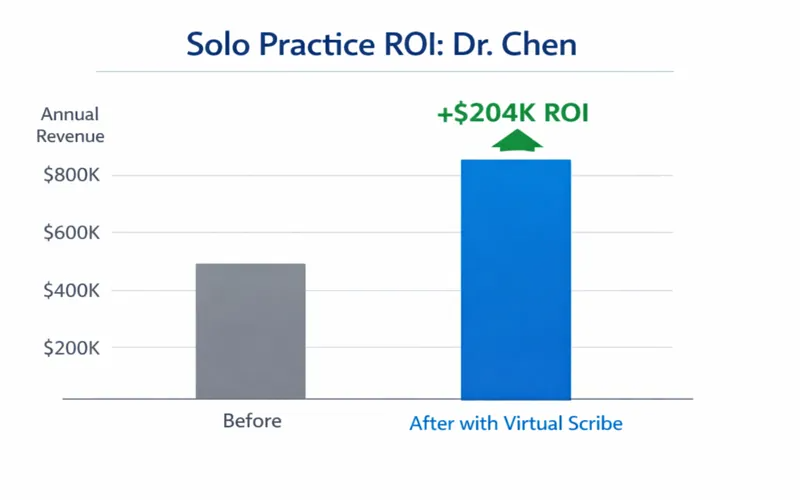
Annual collections: $420,000
After Implementing Virtual Scribe
Service cost: $1,450 monthly ($17,400 annually)
Documentation time: 15 minutes nightly review only
Patients per day: 25 average (3 more daily)
Evening work: None
Weekend charting: None
Burnout level: Renewed passion for medicine
Annual collections: $486,000
Dr. Chen’s Virtual Medical Scribe ROI
Additional revenue: $66,000 annually
Time reclaimed: 15 hours weekly = 780 hours annually
Time value: 780 hours × $200/hour = $156,000
Total benefits: $222,000
Scribe cost: $17,400
Net virtual medical scribe ROI: $204,600 annually
Payback period: 0.9 months (paid for itself in under 1 month)
ROI percentage: 1,176%
“I see my kids before bedtime now. I take real weekends. The financial return is huge, but getting my life back is priceless.”
Understanding medical scribe duties helped Dr. Chen delegate effectively and maximize her ROI.
Real Practice Case Study #2: Three-Physician Internal Medicine Group
Dr. Michael Rodriguez, Dr. Jennifer Park, and Dr. David Kim operate an internal medicine practice in Phoenix. They struggled with high overhead and in-person scribe turnover.
Before Virtual Scribe
In-person scribes: 3 full-time ($210,000 total annual cost)
Turnover rate: 45% annually
Recruitment costs: $18,000 yearly
Training time: 6 weeks per new hire
Management time: 15 hours monthly
Documentation accuracy: Variable by scribe
Total patients daily: 60 across three physicians
After Switching to Virtual Scribes
Service cost: $4,200 monthly ($50,400 annually for three physicians)
Turnover rate: Zero
Recruitment costs: Zero
Training time: Zero
Management time: Zero
Documentation accuracy: Consistently excellent
Total patients daily: 72 across three physicians
The Group’s Virtual Medical Scribe ROI
Eliminated in-person costs: $210,000 annually
New virtual scribe costs: $50,400 annually
Direct savings: $159,600
Additional revenue: 12 more patients daily × $180 average × 240 days = $518,400
Eliminated turnover costs: $18,000
Management time saved: 180 hours × $150/hour = $27,000
Total annual benefits: $723,000
Virtual scribe investment: $50,400
Net virtual medical scribe ROI: $672,600 annually
ROI per physician: $224,200
Payback period: 0.8 months
ROI percentage: 1,334%
Dr. Rodriguez explains their virtual medical scribe ROI exceeded expectations. “We saved money, increased revenue, eliminated headaches, and improved quality. Every metric improved simultaneously.”
Dr. Foster emphasizes the virtual medical scribe ROI transformed her practice model. “I expanded hours without burning out. Patients get faster service. Revenue increased dramatically. The ROI is extraordinary.”
Many urgent care providers also benefit from prior authorization services to streamline the entire patient flow.
Common Virtual Medical Scribe ROI Patterns
Analyzing these three cases reveals consistent virtual medical scribe ROI patterns:
Payback Period
Average payback: 2 to 4 months across all practice sizes
Fastest payback: High-volume practices (urgent care, ER)
Consistent factor: Benefits accumulate immediately while costs stay fixed
ROI Percentage
Typical range: 600% to 3,000% annual return
Key driver: Time savings create multiple revenue opportunities
Better communication: Eye contact and engagement improve patient satisfaction
Physician Wellness
Reduced burnout: Eliminating after-hours work prevents exhaustion
Career longevity: Sustainable practice extends physician careers
Personal time: Evenings and weekends return to physicians
Practice Growth
Scalability: Adding virtual scribes takes days, not months
Flexibility: Adjust coverage as practice volume changes
Competitive advantage: Better service attracts more patients
Making the ROI Decision
The virtual medical scribe ROI evidence across three different practice types shows consistent patterns. Solo practices, group practices, and urgent care centers all achieve similar returns.
Financial ROI: 600% to 3,000% annually
Payback period: 2 to 4 months typically
Revenue increase: $60,000 to $156,000 per physician
Time reclaimed: 10 to 15 hours weekly
Quality of life: Dramatically improved across all cases
The investment risk is minimal with such fast payback. Most practices recover costs within one quarter while gaining immediate time savings and quality of life improvements.
Get Started with ScribeRunner
ScribeRunner provides virtual medical scribe services with proven ROI across hundreds of practices.
Our service delivers:
✅ Guaranteed 10-15 hour weekly time savings
✅ Consistent documentation quality
✅ Automatic backup coverage
✅ All technology included
✅ Flexible scheduling
✅ 24/7 support
Calculate Your Personal ROI
Schedule a free consultation where we calculate your specific virtual medical scribe ROI based on your practice numbers.
📞 Call: (786) 866-7849 Monday through Friday, 8 AM to 6 PM Eastern
Serving medical practices nationwide from Miami, Florida