
Federal law draws a hard line between consumer technology and healthcare technology. Cross that line with the wrong transcription app, and your practice faces penalties reaching $50,000 per violation.
The distinction matters more than most physicians realize. Voice recognition software has become ubiquitous. Your smartphone includes it. Your laptop offers it. Dozens of free apps promise instant transcription. But none of these consumer tools can legally touch Protected Health Information.
Healthcare transcription requires specialized security architecture that most technology companies never build. Business Associate Agreements. End-to-end encryption. Zero data retention policies. Role-based access controls. These protections separate compliant platforms from liability nightmares.
The challenge is identifying which vendors actually implement these safeguards versus which ones simply claim HIPAA compliance in their marketing materials. After evaluating security protocols, medical vocabulary accuracy, and real-world implementation requirements, five platforms consistently demonstrate both legal compliance and clinical utility.
Here’s what separates compliant transcription from compliance theater, followed by the platforms physicians trust with patient data in 2026.
Table of Contents
- What Makes AI Transcription HIPAA Compliant?
- The 5 Best HIPAA Compliant AI Transcription Tools
- Why Consumer Transcription Apps Violate HIPAA
- Frequently Asked Questions
What Makes AI Transcription HIPAA Compliant?
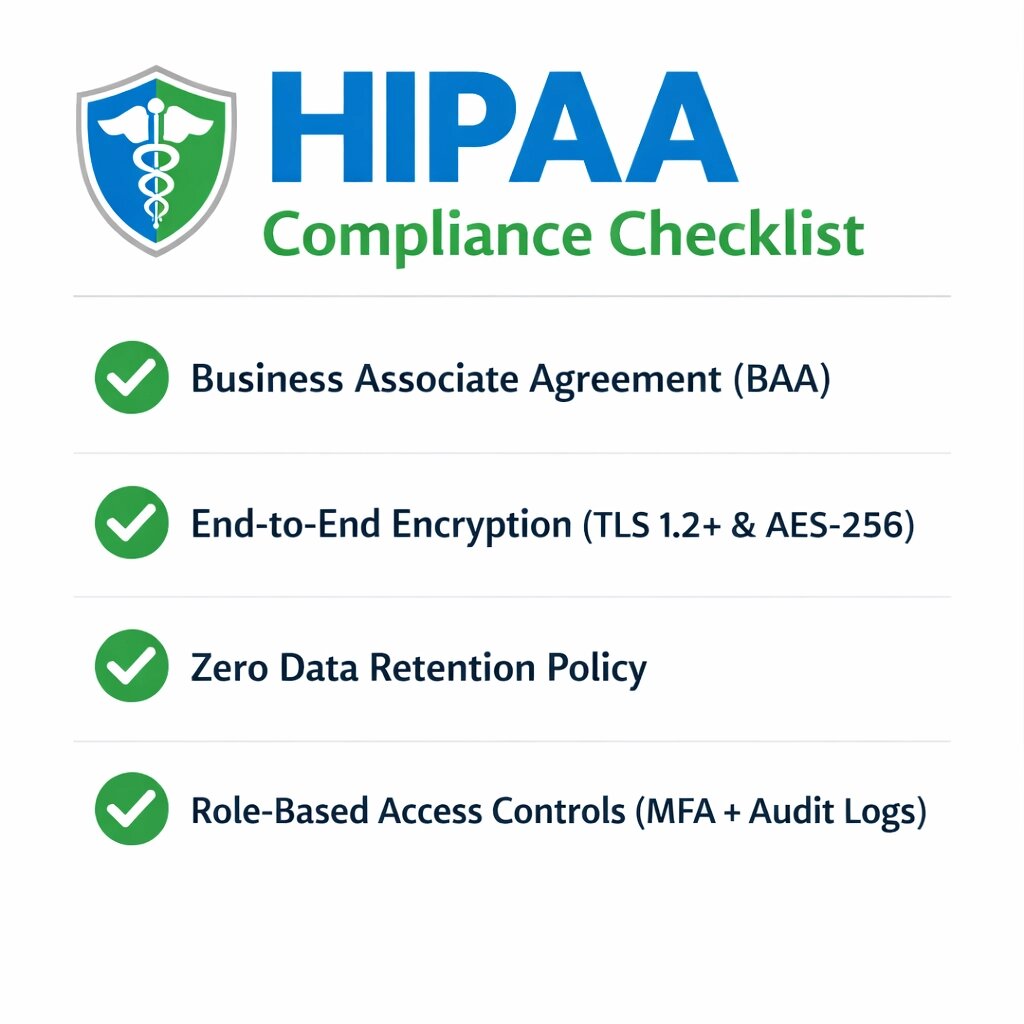
HIPAA compliant transcription software must include four non-negotiable security requirements. Any vendor missing even one of these protections cannot legally handle Protected Health Information.
Business Associate Agreement
A signed Business Associate Agreement legally binds the vendor to HIPAA regulations and transfers liability for data breaches. Software companies that refuse to sign a BAA or hide it behind enterprise pricing cannot be used for clinical documentation.
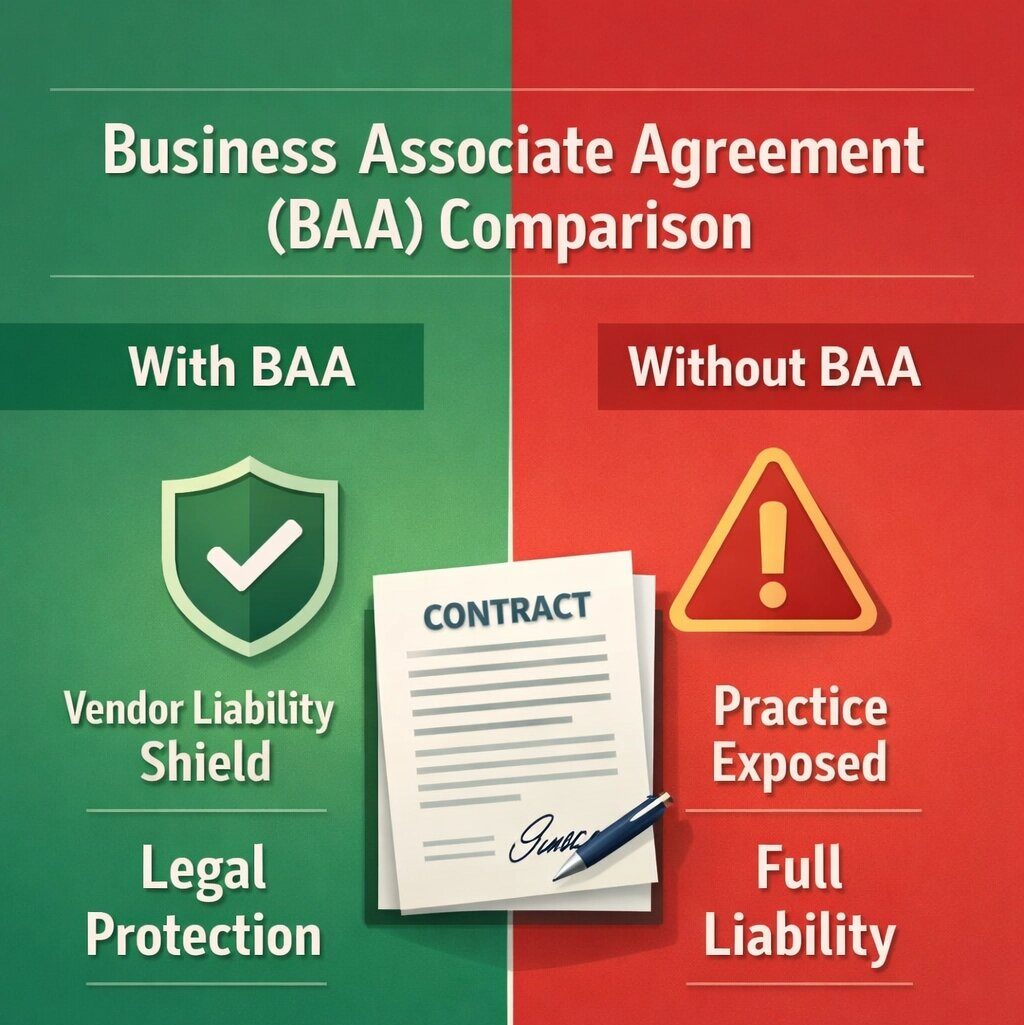
The BAA is not just a formality. It creates a legally enforceable contract that holds vendors accountable if patient data gets compromised. Without this agreement, you assume full legal responsibility for any breach that occurs on their servers.
End-to-End Encryption
Voice data must be encrypted during transmission and storage. This means using TLS 1.2 or higher when audio travels from your device to the vendor’s servers, and AES-256 encryption when storing that data in the cloud.
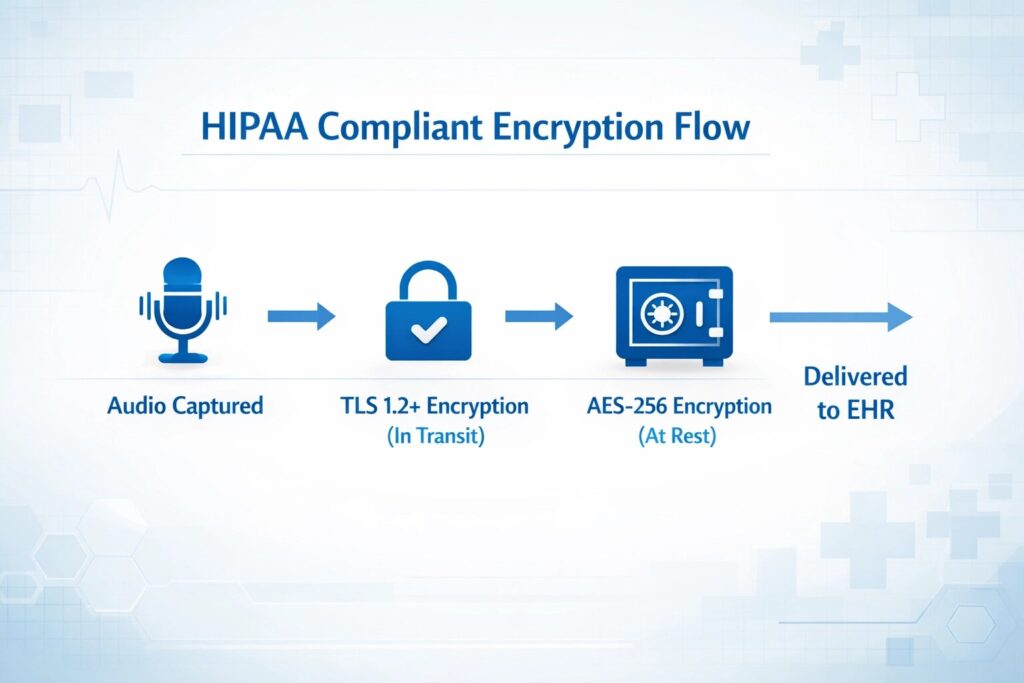
Think of encryption as putting patient information in an armored car during transport, then locking it in a bank vault once it arrives. Both protections must work together to prevent unauthorized access.
Zero Data Retention Policy
This requirement separates healthcare AI from consumer AI. Standard transcription apps store your audio indefinitely to train their language models. That practice violates HIPAA regulations.
Compliant vendors permanently delete audio files and transcripts immediately after delivery to your EHR. No copies remain on their servers. No data gets used for model training. Once the transcript reaches your system, all traces disappear from the vendor’s infrastructure.
Role-Based Access Controls
Even with secure cloud infrastructure, human error inside your practice can cause breaches. Compliant software requires robust access controls including multi-factor authentication, automatic session timeouts, forced password resets, and detailed audit logs.
These audit logs track exactly which user accessed which transcript at what time. If a breach investigation occurs, you can demonstrate proper security protocols were in place.
All reputable platforms must comply with strict HIPAA security requirements established by the Department of Health and Human Services.
Understanding how virtual medical scribes work helps clarify why security requirements differ dramatically from consumer dictation tools.
The 5 Best HIPAA Compliant AI Transcription Tools
After evaluating security protocols, medical vocabulary accuracy, and EHR integration capabilities, these five platforms lead the healthcare transcription market in 2026.
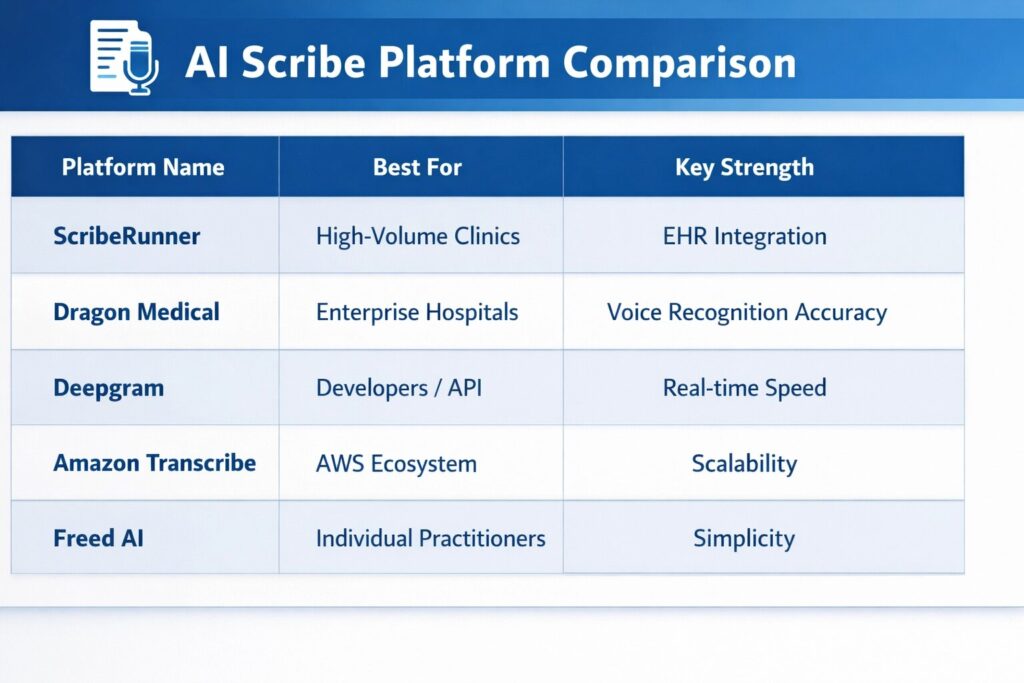
1. ScribeRunner
ScribeRunner delivers ambient clinical intelligence through natural conversation capture. The platform listens to physician-patient encounters, filters medical information from casual dialogue, and generates structured SOAP notes automatically.
Unlike older dictation tools that require explicit punctuation commands, ScribeRunner captures natural conversation. You speak normally with patients while the AI identifies medically relevant information and ignores small talk about weather or traffic.
Key Features:
Medical lexicon accuracy handles complex pharmacology, rare diagnoses, and specialty-specific terminology with 98% accuracy rates. The system recognizes obscure drug names, unusual conditions, and technical jargon across multiple specialties.
Direct EHR integration pushes completed notes into Epic, Cerner, Athenahealth, and eClinicalWorks without manual copy-paste steps. The software populates your HPI fields automatically, places physical exam findings in objective sections, and suggests appropriate billing codes.
Security infrastructure includes full Business Associate Agreement execution, zero data retention policies, AES-256 encryption, and role-based access controls as standard features. No premium tier required for compliance.
Best For: Independent practices and small clinics seeking seamless ambient listening without IT department support.
2. Nuance Dragon Medical One
Dragon Medical One represents the legacy standard in medical dictation. Microsoft-owned Nuance has trained voice profiles for decades, resulting in exceptional out-of-box accuracy across medical specialties.
The platform offers proven reliability through industry-leading accuracy refined over millions of physician voice samples. Dragon understands regional accents, speech patterns, and medical terminology better than newer competitors.
Custom voice commands let you create macros that instantly populate entire documentation blocks. Saying “insert normal physical exam” can generate three paragraphs of standardized text, saving significant time on routine documentation.
Enterprise integration provides deep compatibility with Epic and Cerner hospital systems. Large medical centers already running these EHR platforms find Dragon integrates seamlessly with existing workflows.
Best For: Large hospital networks with dedicated IT resources and enterprise budgets.
Trade-off: Dragon requires higher costs and more complex deployment compared to newer ambient platforms. Implementation often needs IT support and training sessions.
Comparing medical dictation vs medical scribe options helps determine which approach best fits your practice workflow and budget.
3. Deepgram Medical
Deepgram operates as an API-first transcription engine rather than a standalone application. Healthcare developers and large institutions use Deepgram to build custom clinical documentation tools.
Processing speed returns transcripts in milliseconds, enabling real-time documentation workflows. The AI processes audio so quickly that notes appear almost instantaneously as you speak.
Custom model training allows organizations to train AI on specific regional accents or hyper-specialized terminology under secure Business Associate Agreements. A cardiothoracic surgery department can teach the system their unique vocabulary. An urban hospital can train it to understand local dialects.
Developer control provides complete flexibility for custom user interface design and workflow integration. Your IT team builds exactly the documentation tool your practice needs, with Deepgram providing the transcription engine underneath.
Best For: Healthcare systems building proprietary documentation platforms or integrating transcription into telehealth applications.
4. Amazon Transcribe Medical
Amazon Transcribe Medical leverages AWS infrastructure to deliver scalable, API-based transcription for enterprise healthcare organizations processing thousands of hours of audio daily.
Speaker diarization shows exceptional accuracy in separating and labeling multiple speakers. The system clearly identifies when the physician speaks versus when the patient speaks, even distinguishing family members who join the conversation.
Cost efficiency uses pay-per-second pricing at fractions of a cent per audio second. You pay only for actual usage, making it extremely cost-effective for variable-volume practices. A slow week costs less than a busy week.
AWS security infrastructure inherits Amazon’s compliance certifications and cloud security guardrails. The platform benefits from the same security protocols protecting major financial institutions and government agencies.
Best For: Telehealth platforms, clinical trial organizations, and massive hospital networks requiring high-volume processing.
5. Freed AI
Freed AI targets individual clinicians seeking zero-learning-curve ambient documentation. The platform captures encounters on computer or mobile devices and generates formatted clinical notes instantly.
Simplicity defines the user experience. One-button capture with automatic formatting into standard medical note structures. You press start, conduct your visit, press stop, and review the completed note.
Clinician-centric design lets you review, edit, and copy formatted notes directly into any EHR system. The output matches standard documentation formats, requiring minimal adjustment before final approval.
HIPAA compliance comes standard with Business Associate Agreement offering and enterprise-grade security. No complicated configurations or IT setup required.
Best For: Solo practitioners and small practices wanting immediate implementation without technical complexity.
Comparing the pros and cons of medical scribes helps determine whether AI transcription or human virtual scribes better fit your practice needs.
Why Consumer Transcription Apps Violate HIPAA
Physicians occasionally attempt using consumer transcription apps to record patient summaries. The logic usually follows: “I’ll just leave out the patient’s name, so it’s not Protected Health Information.”
This assumption creates severe legal exposure.
The 18 Identifier Problem
Protected Health Information includes 18 specific identifiers beyond patient names. Even without names, the combination of dates of service, specific diagnoses, geographic information, unique medical conditions, and treatment details renders transcripts identifiable under HIPAA regulations.
A transcript stating “58-year-old male from Miami with Stage 3 pancreatic cancer seen on March 15, 2026” remains identifiable even without a name. The combination of age, location, diagnosis, and date creates a unique identifier.
How Consumer Apps Violate HIPAA
Standard transcription platforms explicitly state in their terms of service that they store data on unsecured servers without healthcare-specific encryption. Your audio files sit on general-purpose cloud storage alongside millions of other recordings.
These platforms use audio to train public AI models, permanently exposing patient information. Every recording you make helps improve their speech recognition for all users. That means patient conversations become part of their training dataset forever.
Consumer apps allow human review of audio snippets for quality assurance. Real people listen to random segments to verify accuracy. Those reviewers have no HIPAA training and no legal obligation to protect patient privacy.
Finally, these companies refuse to sign Business Associate Agreements, avoiding legal liability for breaches. If their servers get hacked and your patient data leaks, you bear full responsibility.
The Financial Risk
Office for Civil Rights fines for willful neglect reach $50,000 per violation. A single day seeing 20 patients using non-compliant apps could generate $1 million in penalties.
Recent OCR enforcement actions show aggressive prosecution of providers who use non-compliant technology. The agency does not accept ignorance as an excuse.
Investing in secure AI medical dictation costs far less than a single OCR audit finding. The annual subscription fee for compliant software represents a fraction of one violation penalty.
For more on legal boundaries and security requirements, see our guide on medical scribe duties and scope of practice.
Frequently Asked Questions
No. The consumer version of Otter.ai does not offer HIPAA compliance or sign Business Associate Agreements. Healthcare providers must use enterprise versions with explicit HIPAA compliance features or switch to dedicated medical transcription platforms like ScribeRunner or Dragon Medical.
Yes, provided you use HIPAA compliant transcription software that signs a Business Associate Agreement, encrypts data end-to-end, and maintains zero data retention policies. Consumer AI transcription tools violate HIPAA and cannot legally process patient encounters.
AI-powered platforms with specialized medical training, including ScribeRunner, Dragon Medical One, and Deepgram Medical, achieve 98% accuracy rates on medical terminology. Accuracy depends on audio quality, speaker clarity, and specialty-specific vocabulary complexity.
Pricing varies significantly by platform. Individual subscriptions range from $99 to $299 per month for services like Freed AI and ScribeRunner. Enterprise licensing for Dragon Medical typically costs $300 to $500 per physician annually. API-based pricing through Deepgram or Amazon Transcribe runs $0.02 to $0.05 per minute of audio.
Cost should be evaluated against time savings and HIPAA violation risk. The investment in compliant software represents insurance against far larger penalties.
Federal HIPAA regulations generally permit recording clinical encounters for treatment documentation without explicit consent. However, state laws vary. California, Illinois, and several other states require two-party consent for recording conversations. Consult your malpractice attorney for state-specific requirements before implementing any transcription system.
OCR audits finding non-compliant transcription tools result in immediate violation notices requiring corrective action plans. Fines range from $100 to $50,000 per violation depending on negligence level. Settlements often require expensive security upgrades and ongoing monitoring.
Violations become public record, damaging practice reputation. Individual physicians face personal liability for choosing non-compliant tools, even within larger healthcare organizations.
The financial and reputational damage far exceeds the cost of compliant software. Prevention costs less than remediation.
Understanding the best AI medical scribe software options helps you select platforms that balance security, functionality, and cost.
Stop Charting at Midnight. Start Living Again.
ScribeRunner’s virtual scribes handle your documentation while you focus on patients.
Why Physicians Choose Us:
✅ 90% complete notes before patients leave
✅ No long-term contracts, cancel anytime
✅ Go live in 7 days with your EHR
✅ HIPAA certified with bank-level security
Schedule Free Consultation
📞 Call: (786) 866-7849 | Mon-Fri, 8AM-6PM EST Serving practices nationwide from Miami, FL