
You did not enter medical school just to work as a data entry clerk.
But here you are, spending most of your time staring at a computer-monitor, as much as you do whatsoever you are looking at your patients. The irony isn’t lost on anyone. You were trained to diagnose, to treat and to heal. Not to have boxes to click and notes to type till midnight.
Medical scribe is not a new concept. It is only logical that a person who does the documentation be someone else and you concentrate on patients. However, forced to board another human being into your already crowded exam room? That’s not always practical. Virtual medical scribes come in there.
When you think of remote scribes, you must be asking yourself: is somebody listening? How do they access my EHR? Is this actually secure? Is my patient going to be okay with it? Understanding the differences between virtual vs in-person scribes helps you choose the right model for your practice.
The response to all these questions: Yes. And the procedure is very easy.
According to recent physician burnout statistics, research on the EHR documentation burden shows physicians spend nearly half their work time on documentation tasks. Remote scribe implementation cuts that burden dramatically. The benefits of medical scribes extend beyond simple time savings to include revenue increases and burnout reduction.
This is how the virtual medical scribes operate in detail.
Table of Contents
- The Virtual Scribe Workflow: 3 Simple Steps
- What You Need to Get Started
- Is This Actually Secure?
- Getting Your Scribe Up to Speed
- Common Questions
- The Bottom Line
The Virtual Scribe Workflow: 3 Easy Steps.
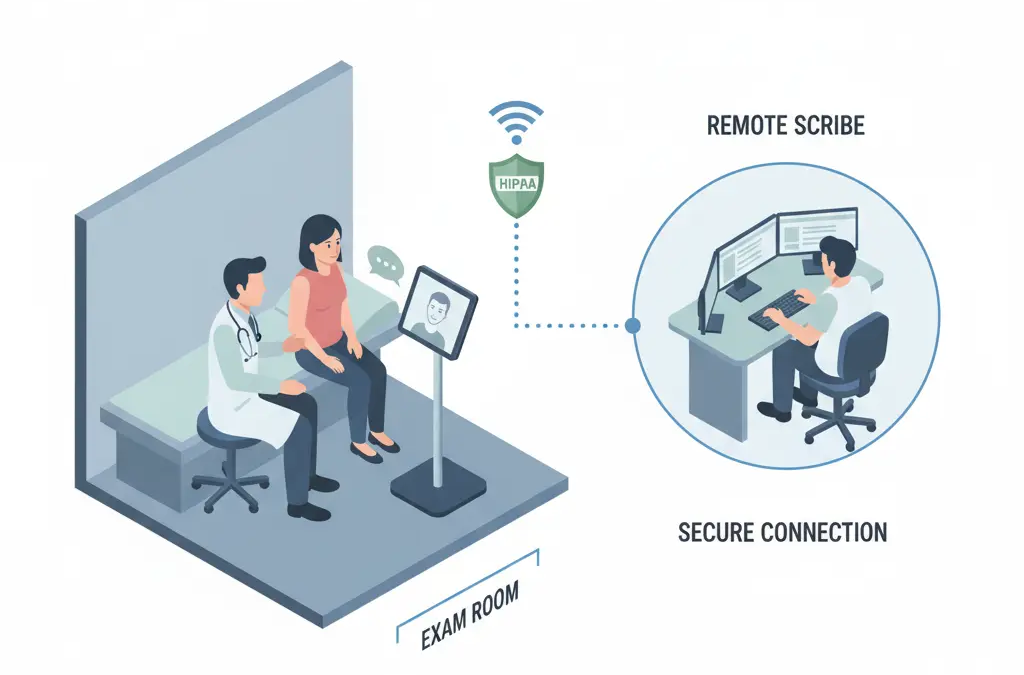
Virtual scribes exist and they are actual trained professionals who are off-site and they act by listening to your experiences and recording them live.
It involves creating a secure connection that prevents any third parties from intercepting communication between two parties via the Inter-rater communication system.
Pick a tablet or a smartphone with the scribe app before going into exam room.
The process:
- Tap “Connect” on your device
- Walk in the room, introduce the scribe: “I have my assistant, Alex, who will write down everything so that I can concentrate on you.
- Install the device in a position that it can effectively pick up the conversation.
Most systems comprise audio only, whereas a few have video. Patients will normally agree and enjoy the additional attention.

Step 2: EHR Documentation in Real-Time.
Meanwhile, exploring the patient, the scribe is literally inside your EHR and is documenting all the information in real-time using a secure remote connection.
What they document:
- Translating patient words into medical terms: Chief Complaint.
- Checking off: Symptoms discussed: Checking off.
- Physical Exam: Typing your described results (“Lungs clear bilaterally”)
- Assessment & Plan: Make up diagnosis and place orders with your review.
The advantage? Notes are constructed in the presence of the patient in the room, not hours later according to the memory.
Step 3: Rapid Inspection and Sign-Off.
Upon patient discharge, 90% of the documents are filled. The average time spent on a doctor checking, confirming billing codes and signing off is 30-60 seconds.
The result? Discharge at 5 PM with closed charts. Finishing notes were not to be done at home anymore.
What You Need to Get Started
The good news? You most likely have all that you needed. There is no need of a huge technology overhaul to have virtual scribes.
Hardware:
- Microphone-equipped device (iPad, smartphone or laptop)
- A computer in which you can access EHR.
- That’s essentially it
Software & Connectivity:
- Fast internet (not negotiable- ensures clear audio)
- Communicational platform (offered by your scribe firm)
- Your EHR (VPN, Citrix or cloud login) Remote access.
Their current set up can be used to initiate most of the practices within one week. Following EHR services ensures your transition runs smoothly from day one.
Is This Actually Secure?
Yes. The reputable virtual scribe companies apply several security layers:
Encrypted Connections:
Audio and video are encrypted at 256-bit, which is the same as the banks.
No Data Storage:
Scribes operate directly in your EHR. None of the patient information remains in their device following the session.
HIPAA Compliance:
All professional scribe services follow strict protocols mandated by HIPAA compliance requirements:
- All scribes to be HIPAA trained and certified.
- The Business Associate Agreements (BAAs) with your practice.
- Background investigations of every staff.
- Lock work areas that have no recording tools.
- Mechanical screens and watched areas.
Contracting a high-profile service is safe as in-office types–better in many cases.
Teaching Your Scribe on the Rush.
The initial week is regarding style matching. Here’s how:
Share Your Preferences:
- Templates, shortcuts of EHRs you make.
- Preference in the structure of notes (concise or detailed)
- Ordinary phrases and documentation models.
Narrate Your Exams:
Become comfortable dictating findings. What you see your scribe can not, unless you tell him.
Keep Communication Open:
Checking in during the week one is short, but it assists in fine-tuning workflow. Be sure to treat your scribe as a team member. When choosing a virtual scribe service, look for providers who prioritize this personalized training approach.
Frequently Asked Questions
Yes. They are able to hear the whole interaction through secure audio in order to record down all the information to be properly documented. This will involve the interviewing of the patient, physical examination dictation and treatment planning.
A phone (smartphone, tablet, or laptop) and a high-speed internet that is reliable. The majority of the practices work with the devices they already have in possession.
Yes. Credible services employ encrypted connections, HIPAA educated scribes and sign Business Associate Agreements with your practice.
In your EHR, scribes place orders on your behalf, but you go through them and sign before final. All the clinical decisions remain under your control.
You would recorded that visit yourself. Nonetheless, there are back up internet or mobile hotspots to most practices and outages are hard to come by.
The Bottom Line
Working Virtual medical scribes establish a safe, real-time connection between your exam room and a qualified professional who does the paperwork and you concentrate on patient care.
The workflow is simple:
- Connect to your scribe
- Visit as you would have done otherwise (during your narration of your exam)
- Quick review and sign-off
The technology is affordable. The security is robust. And it has a direct effect on your work-life balance.
A virtual scribe could be the best solution to a change that you make in the year, provided that you are willing to drop typing and begin connecting with patients once again.

Want Your Evenings Back?
Stop spending your nights with charts being completed. Start going home on time.
The HIPAA-compliant virtual scribes of ScribeRunner take care of the paperwork while you can concentrate on the most important part of patient care.
What ScribeRunner Offers:
- Documentation by the trained medical professionals on a visit-by-visit basis.
- 90% done notes prior to patient exiting the room.
- Keep work hours- get rid of after-hours charting.
- Greater interaction with patients, reduced screen time.
- Fluid EHR connection – integrates with Epic, Athena, and Cerner.
- HIPAA and encrypted connections and BAAs.
Our Process:
- Week 1: Rapid onboarding and training of what you want.
- Week 2: Complete integration into your workflow.
- Week 3 and beyond: Home on time, all the time.
Transparent Pricing:
- No setup fees
- No long-term contracts
- Cancel anytime
- Free counseling on your requirements.
Contact us to discuss your specialty-specific needs:
- Phone: (786) 866-7849
- Location: 25 SE 2nd Ave, Suite 1030, Miami, FL 33131
- Hours: Monday-Friday, 8 AM-6 PM EST
- Service Areas: Miami, Fort Lauderdale, Tampa, Orlando, and practices nationwide