
You know the scene. You are sitting in the exam room conceptualizing, saying the symptoms, yet the doctor is looking at the computer screen typing wildly. They nod occasionally. Eye contact remains rare.
It is not as though they do not care. Modern medicine made doctors high-paid mere data entry clerks.
To get out of this fix, medical scribes are the answer.
Scribes are the human barrier in physician burnout. They cover clerical weight to allow the providers to practice medicine. However, to the practice manager and those who aspire to be scribes, the boundaries are blurred. Does a scribe just type? Are they able to give doctors scalpels? Are they able to comprehend lab results?
Knowledge of medical scribe responsibilities is not restricted to job descriptions, but covers the areas of legal, liability and patient safety.
This is the finalized scopes of practice of medical scribe.
Table of Contents
- Comprehensive List of Medical Scribe Duties
- What Can a Medical Scribe do in the EMR?
- Do Not Touch: The List of Things Scribes Cannot Do.
- Virtual Scribe Scope of Practice vs. In-Person Scribes.
Comprehensive List of Medical Scribe Duties
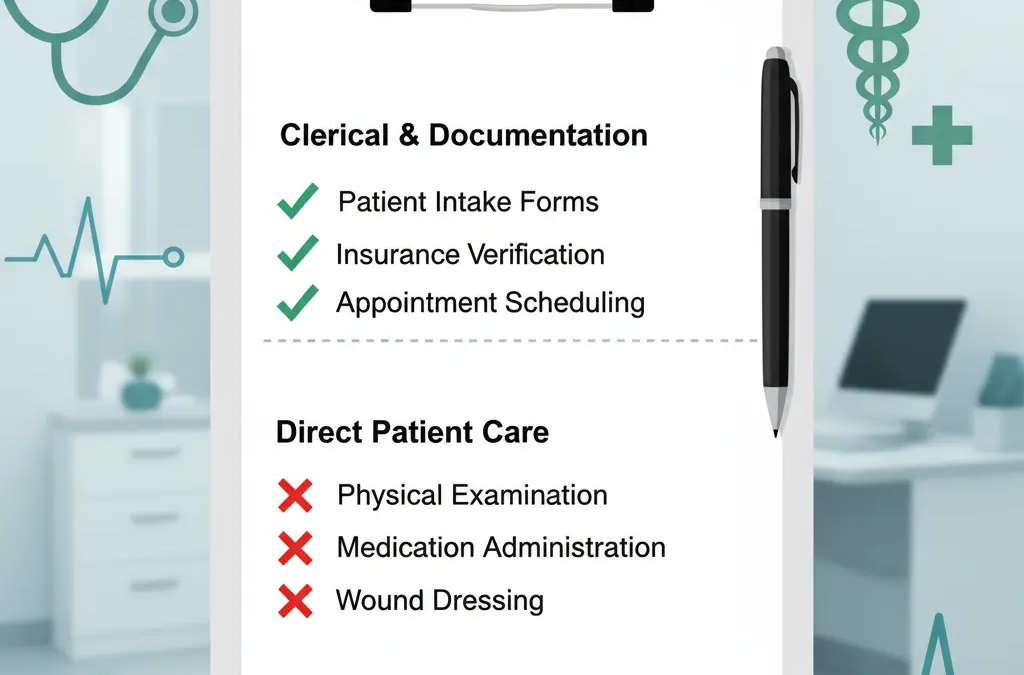
Consider medical scribers as provider specialist personal assistants. Their major objective: productivity. Scribes normally do most tasks that do not involve a medical license or physical contact with patients.
Certain working processes differ depending on the specialty (Emergency Medicine vs Dermatology), yet, seminal duties are similar.
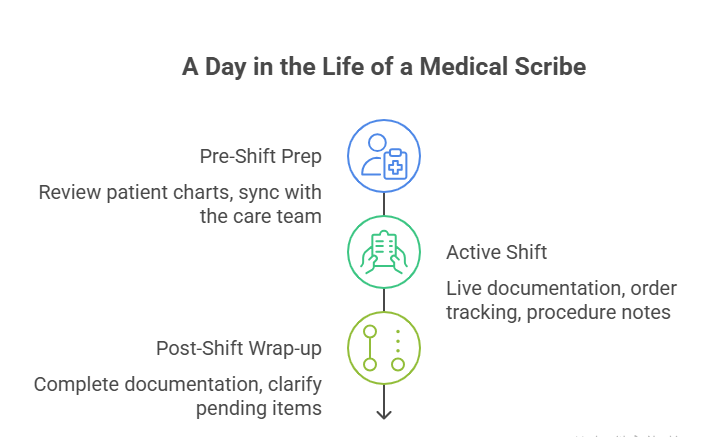
A standard shift involves:
- Real-time Documentation: Writing direct interaction of the patient and physician in the Electronic Medical Records.
- Information Retrieval: Non-current care: Searching past medical records, past X-rays, or of late lab results to allow the provider to review.
- Workflow Management: Monitoring those patients who have their lab waiting, those who require to be sent home, and reminding the provider of time-sensitive actions.
- Clerical Assistance answering group calls, sending documents by a fax machine or printing discharge instructions.
Scribes play the role of flies on the wall. It is through documentation that they document events that happen and not through being involved.
What Can a Medical Scribe Do in the EMR?
The EMR is the natural habitat of the scribe. 90% of work occurs in the EMR. Nonetheless, the access to the EMRs does not imply that the scribes can press all the buttons.
This is what can be done by medical scribes within electronic records.
Past Medical History (HPI) and Review of Systems (ROS)
HPI narrates about the reason why patients come.
The Scribes Role: Scribes are the listeners of the discussions and translators of the patient complaints into medical language. Scribes write when patients remark, My belly hurts after I eat grease, Postprandial abdominal pain made worse with fatty foods.
The Boundary: The scribes are not allowed to make an assumption of facts not stated. They record fatally what is said in rooms.
In the case of Review of Systems, scribes are asked to tick the symptoms according to how patients responded to questions posed by the physician.
Physical Examination Report
The area where the scopes of practice of a medical scribe are the most confusing one.
Physical exams cannot be done by scribes. Nonetheless, they are able to record findings of physical examination as stipulated by providers.
How it works:
Doctors check up patients and address them either in-room or right after leaving: Heart regular rate and rhythm, lungs clear to auscultation, abdomen soft and non-tender.
Scribes record those results in physical examination templates. Scribes perform the role of stenographers. They do not validate results- they take down doctor records.
Pending Labs and Imaging Orders
Major time is saved by scribes on orders.
When the physician makes the statement, Let us order a CBC, BMP, and Chest X-Ray the scribes will go to the order entry screens and choose the test.
The catch:
Scribes can only “pend” orders. They are not able to sign or to file them. Orders are held in queues awaiting physician electronic signatures (or verbal confirmation as per the by-laws of the hospital) to become active. This will make sure the physicians inspect the accuracy of order prior to the actions of nurses.
Do Not Touch List: What Scribes Can not Do
Keep this in mind: Scribes are not clinical.
How so, whether the scribes are graduate third-year medical students, or retired nurses doing the side jobs, when clocked in as scribes, their license is practically inexistent. Breaking these lines will release practices to huge liability suits.
Clinical Procedures and Patient Care
Medical scribes are not supposed to touch patients.
Strictly prohibited actions:
- Contact with patients: This is when one is assisting patients to stand up, or holding patients during operations and palpating injuries.
- Handling Fluids: Scribes are not able to collect urine, clean blood or to deal with emesis basins.
- Procedures: No suture removal, no injections, no taking of vitals (unless dual-certified and role specifically permits it, which is uncommon and legally a confusing and challenging area)
Should patients request water or blankets, most restrictive hospital environments will compel scribes to request nurses or techs to do so. This makes sure that scribes will not violate NPO (nothing by mouth) orders or infection control measures.
Giving Medical Advice
Most of the time, eager pre-med scribes fall into this trap. When left alone, patients may go to the scribes to seek his or her opinion on whether their ankle is broken. or What does that result of the test mean?
Scribes cannot answer. No matter whether bones jut out on the legs and breaks are apparently obvious, scribes are unable to certify.
The Writing of the Scribe: I am only recording your visit; the physician will come round just now to speak to you about that.
The scribes are not able to read results, clarify prescriptions and provide opinion on the treatment plan. They are just the onlookers.
Virtual Scribe Scope of Practice and In-Person Scribes
Virtual scribes gained popularity by Telehealth. Such scribes communicate via secure video or audio devices.
Does medical scribe scope of practice change when scribes work remotely?ing remotely?
Physically? Yes.
Virtual scribes are not able to pick items on behalf of doctors or deliver them charts. This avoids the possibility of unintentional contact with patients, as some risk-averse hospital systems prefer.
Digitally? No.
EMR duties remain identical. Virtual scribes still:
- Document HPI and Exams
- Pend orders for review
- Poor prescription and independent order sign.
The main difference: audio quality. Virtual scribes depend fully on physicians talking in their turn into microphones. Face-to-face scribes have the advantage of receiving visual clues otherwise inaccessible to the virtual scribe (a doctor pointing to left knees) means that providers have to explain results verbally.
FAQ
Can a medical scribe touch a patient?
No. Medical scribes are not clinical employees in any way. They cannot touch patients or conduct physical exams, to inoculate patients or quite literally touch fluids. They are only able to work as far as documentation and clerical support.
Can scribes send prescriptions?
Prescriptions may be entered or ‘pended’ by medical scribes based on the instructions of physicians into Electronic Medical Records, but may not be legally signed or transmitted to pharmacies.
Should medical scribes be certified?
Although there is no certification requirement in federal law, most legitimate scribe agencies demand training in HIPAA and in particular, medical terminology. Certain employers can demand such certifications as MSCAT.
The Bottom Line
Medical scribes serve as copilots in healthcare. They handle navigation and radio logs so pilots (physicians) can fly planes.
Strict adherence to these boundaries protects scribes and practices while ensuring doctors focus on what matters most: patients.
ScribeRunner’s medical scribes are trained, certified, and monitored to ensure perfect compliance with legal boundaries.
Our Compliance Guarantee:
✓ HIPAA Certified – All scribes complete 40-hour HIPAA training
✓ Background Checked – Every scribe undergoes federal background screening
✓ Scope-Trained – Specialty-specific training on what they can/cannot do
✓ Continuously Monitored – Quality assurance reviews every week
What Our Scribes CAN Do:
- Document HPI, ROS, Physical Exam in real-time
- Navigate your EMR and locate previous records
- Pend labs, imaging, and prescriptions for your review
- Enter orders, referral letters, and discharge instructions
- Track workflow and remind you of pending tasks
What Our Scribes Will NEVER Do:
- Make clinical decisions without your approval
- Touch patients or perform clinical procedures
- Give medical advice or interpret results
- Sign orders or prescriptions independently