
You entered medicine to treat patients, not to become a data entry specialist. Yet, here you are—spending your evenings in “pajama time,” finishing charts, or listening to your front desk staff complain about being overwhelmed by phone calls and prior authorizations.
You know you need help. You’ve heard about remote staffing solutions. But when you look at the options, the lines get blurry. Do you need someone to manage your calendar, or do you need someone inside the exam room (virtually) writing your notes?
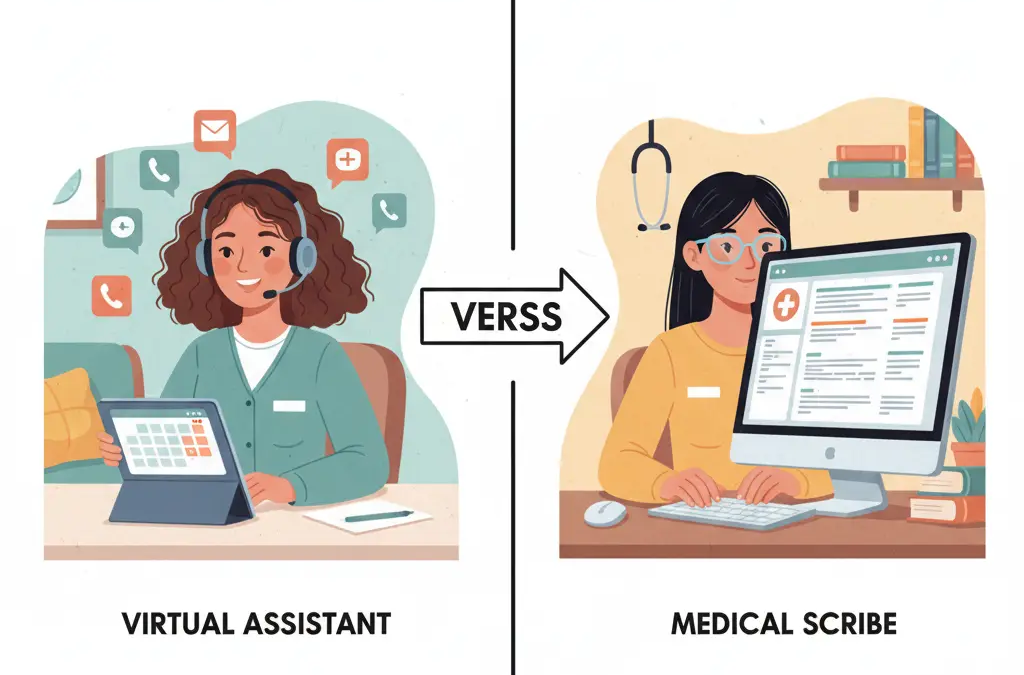
The difference between a Medical Virtual Assistant (MVA) and a Medical Scribe isn’t just semantics; it’s the difference between fixing your front desk chaos and fixing your clinical burnout.
Here is exactly how to choose the right remote professional for your specific bottleneck.
Table of Contents
- Key Differences Between a Medical Virtual Assistant and a Scribe
- What Does a Medical Virtual Assistant Do?
- What Does a Virtual Medical Scribe Do?
- Cost Comparison: VA vs. Scribe Services
- How to Choose Based on Your Clinic’s Bottlenecks
- Frequently Asked Question
Key Differences Between a Medical Virtual Assistant and a Scribe
Think of your practice as a theater production.
A Medical Virtual Assistant is the stage manager. They are behind the scenes ensuring the tickets are sold, the schedule is set, the insurance companies are paid, and the audience (patients) knows where to go. They face the business side of your practice.
A Medical Scribe is right there on stage with you. They don’t talk to the audience, but they record every line, every movement, and every decision in real-time. They face the clinical side of your practice.
While both work remotely and log into your systems, their objectives are fundamentally different.
Comparison Table: Responsibilities, Access Levels, and Training
To settle the medical virtual assistant vs medical scribe debate, look at this breakdown of daily operations:
| Feature | Medical Virtual Assistant (MVA) | Virtual Medical Scribe |
|---|---|---|
| Primary Focus | Administrative workflow & patient coordination | Clinical documentation & provider support |
| Patient Interaction | High (Phone, Email, SMS, Scheduling) | None to Low (Passive listener during visits) |
| EMR Access | Scheduling, Demographics, Billing, Insurance | Clinical Charts, SOAP Notes, Lab Orders, Coding |
| Training | Customer service, HIPAA, Admin software | Medical terminology, Anatomy, Coding, Charting |
| Work Style | Task-oriented (multitasking) | Focus-oriented (real-time tracking) |
What Does a Medical Virtual Assistant Do?
If your bottleneck is administrative friction, phones ringing off the hook, referrals falling through the cracks, or insurance verification lagging, you are looking for a Medical Virtual Assistant.
MVAs are the remote extension of your front desk. They clear the path so the patient can actually get into the exam room.
Administrative Tasks and Patient Coordination
Virtual medical assistant duties generally cover everything that happens before and after the appointment. They are the gatekeepers.
- Phone Triage: They handle high volumes of incoming calls, filtering out what needs immediate clinical attention and what is just a scheduling request.
- Insurance Verification: One of the biggest time-sucks for in-house staff. An MVA checks eligibility and benefits days before the patient arrives.
- Prior Authorizations: They sit on hold with payers so your high-paid nurses don’t have to.
- Referral Management: Closing the loop on incoming and outgoing referrals to ensure continuity of care (and revenue retention).
- Schedule Optimization: Filling cancellations and confirming appointments to reduce your no-show rate.
An MVA is essentially an admin specialist who happens to understand HIPAA.
What Does a Virtual Medical Scribe Do?
If your bottleneck is clinical documentation, meaning you are staying late to finish charts or your notes lack detail because you’re rushing, you need a Virtual Medical Scribe.
Scribes are “fly on the wall” professionals. They connect via a secure audio/video link during the patient visit. They listen, they observe, and they type.
Clinical Documentation and EMR Management
When comparing remote scribe vs admin roles, the scribe is highly specialized. They require a grasp of pathophysiology and pharmacology that an admin assistant simply doesn’t have.
- Real-Time Charting: As you speak to the patient (“Patient presents with 3 days of productive cough…”), the scribe enters this immediately into the HPI.
- Review of Systems (ROS): They check off the systems as you ask the questions.
- Order Entry: Many scribes draft lab and imaging orders for you to sign off on.
- ICD-10 and CPT Coding: Scribes ensure your documentation supports the billing codes you select, reducing down-coding or audits.
- After-Visit Summaries: They generate the instructions for the patient before they even leave the room.
The goal of the scribe is to ensure that when you walk out of the exam room, the chart is 90% to 100% complete.
Cost Comparison: VA vs. Scribe Services
Pricing is often the deciding factor, but you have to look at ROI, not just the hourly rate.
Medical Virtual Assistants generally cost less.
Because their work is administrative and repetitive, the training threshold is lower. You can typically find high-quality offshore MVAs ranging from $8 to $14 per hour, or domestic ones for $18 to $25 per hour.
Medical Scribes command a premium.
You are paying for clinical intelligence. A scribe needs to know the difference between “peroneal” and “perineal” without asking.
- Offshore virtual scribes typically range from $10 to $18 per hour.
- Domestic virtual scribes range from $20 to $35+ per hour.
The ROI Calculation:
- If an MVA saves your front desk 20 hours a week, you might avoid hiring another full-time receptionist.
- If a Scribe saves you (the doctor) 2 hours a day, that allows you to see 2-4 extra patients. The revenue from those extra visits usually covers the cost of the scribe five times over.
How to Choose Based on Your Clinic’s Bottlenecks
Still on the fence? Don’t look at job descriptions; look at your pain points.
Hire a Medical Virtual Assistant (MVA) IF:
- Your phones are a nightmare. Patients complain they can’t get through, or your in-office staff looks stressed every time the phone rings.
- Denials are up. You are seeing revenue leakage because eligibility wasn’t checked or prior auths weren’t submitted on time.
- Your schedule has holes. You have a high no-show rate because no one has time to call and confirm appointments.
Hire a Virtual Medical Scribe IF:
- You have “Pajama Time.” You are routinely charting at home after dinner.
- You stare at the screen, not the patient. You feel like a data entry clerk during visits, which hurts the patient relationship.
- Your billing is lagging. You wait until the weekend to close charts, which delays claims submission and cash flow.
Frequently Asked Questions
The primary difference is that a medical scribe focuses exclusively on clinical documentation and EMR management during patient visits, whereas a medical virtual assistant handles administrative tasks like scheduling, insurance verification, and patient communication. Think of the scribe as the doctor’s personal clinical secretary, and the assistant as the practice’s administrative coordinator.
Generally, no. Most virtual assistants lack the specific clinical training, medical terminology knowledge, and EMR expertise required to document patient encounters accurately in real-time. Asking an admin VA to scribe usually results in poor documentation and increased editing work for the physician.
Medical scribes often command a slightly higher hourly rate than general medical virtual assistants due to their specialized clinical training and direct impact on physician revenue through accurate coding. However, the ROI on a scribe is often higher because they free up the physician to bill for more patient visits.
Summary
If your problem is the business of medicine, hire a Medical Virtual Assistant.
If your problem is the practice of medicine, hire a Medical Scribe.
Don’t try to make one person do both roles. The skill sets are distinct, and attempting to find a “unicorn” who can verify insurance and document a complex differential diagnosis usually leads to mediocrity in both areas. Identify your biggest bottleneck, hire the specialist that solves it, and get your time back.