

Most physicians think hiring an in-person medical scribe costs less than a virtual scribe service. They see the hourly wage and assume it’s the cheaper option. That assumption costs practices thousands every month.
The real cost includes far more than salary. When you add up workspace, equipment, benefits, training, and turnover, in-person scribes become surprisingly expensive. Virtual scribe services eliminate most of these hidden costs.
This guide shows you the actual numbers. You’ll see exactly what each option costs and where your money goes.
How the Two Models Work
Understanding each scribe model helps clarify why costs differ so dramatically.
In-Person Medical Scribes
An in-person scribe sits in your exam room during patient visits. They accompany you throughout the day, documenting every encounter in real-time. This model requires physical workspace in your practice.
You hire them as employees, which means you pay their salary plus all employment costs. When they call in sick or quit, you scramble to find coverage or handle documentation yourself.
Learning how virtual medical scribes work shows the alternative approach that eliminates many of these challenges.
Virtual Medical Scribes
A virtual scribe works remotely from a secure location. They listen to your patient encounters through audio feeds and document appointments in real-time. No physical presence needed in your office.
Learning how virtual medical scribes work shows the alternative approach that eliminates many of these challenges. You pay a monthly subscription to a service provider. They handle hiring, training, management, and backup coverage. When your scribe is unavailable, another trained professional steps in immediately.
The Complete Cost Comparison
Here’s what each scribe model actually costs when you include everything:
Annual Cost Comparison Table
| Cost Category | In-Person Scribe | Virtual Scribe Service |
|---|---|---|
| Base Salary/Service Fee | $31,200 – $52,000 | $14,400 – $21,600 |
| Payroll Taxes (FICA, unemployment) | $2,400 – $4,000 | $0 |
| Benefits (health, dental, vision, PTO) | $9,400 – $20,800 | $0 |
| Workers Compensation Insurance | $500 – $1,500 | $0 |
| Workspace & Equipment (desk, computer, EHR license) | $4,100 – $10,900 | $0 |
| Recruitment & Training | $5,900 – $18,500 | $0 |
| Management & Supervision | $4,400 – $8,800 | $0 |
| Backup Coverage | $3,000 – $12,000 | Included |
| Turnover Costs (annual average) | $2,000 – $12,000 | $0 |
| TOTAL ANNUAL COST | $62,900 – $140,500 | $14,400 – $21,600 |
| YOUR SAVINGS | — | $41,300 – $118,900 |
The numbers tell a clear story. Virtual scribe services cost 60% to 75% less than employing an in-person scribe. Data from the Medical Group Management Association confirms these employment costs are consistent across medical practices nationwide, making virtual solutions an increasingly attractive option.
Breaking Down the Hidden Costs
Most practices underestimate what in-person scribes truly cost. Let’s examine where the hidden expenses come from.
Workspace and Equipment
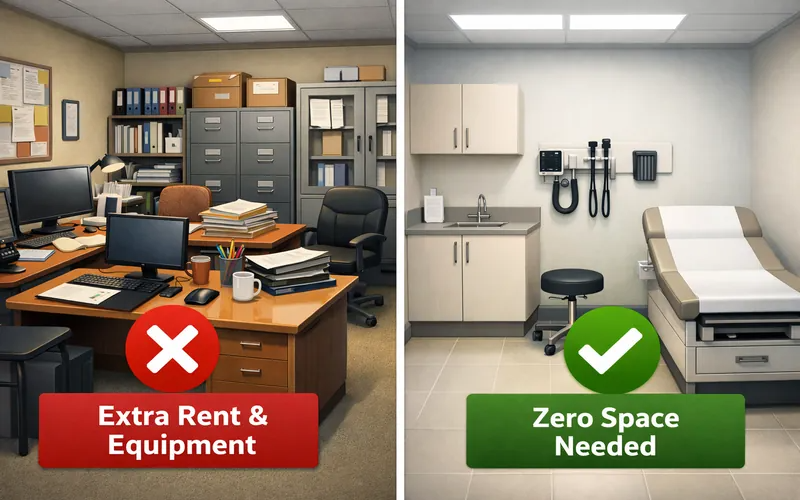
Each in-person scribe needs a dedicated workstation. That means a desk, chair, computer, dual monitors, and space in your office. Commercial medical office space costs $25 to $50 per square foot annually.
A scribe’s workstation occupies about 60 square feet. You’re paying $1,500 to $3,000 yearly just for the floor space. Add computer equipment, EHR licensing, and IT support, and workspace costs reach $4,000 to $11,000 in the first year.
Virtual scribes need none of this. They work from their own location with their own equipment.
Benefits and Payroll Taxes
The hourly wage is just the starting point. Federal law requires you to pay Social Security, Medicare, and unemployment taxes. That’s another 7.65% minimum on every dollar.
Then come benefits. Health insurance alone costs $6,000 to $12,000 annually per employee. Add dental, vision, paid time off, and retirement matching. Benefits typically add 30% to 40% to base salary. According to the Bureau of Labor Statistics, benefits typically add 30% to 40% to base salary.
Virtual scribe services include everything in the monthly fee. No separate benefits. No payroll taxes. No surprises.
Training and Onboarding
New scribes need extensive training before they become productive. They must learn medical terminology, your EHR system, your documentation preferences, and your workflow. Understanding medical scribe duties clarifies the complexity of proper training.
This training takes 4 to 8 weeks. During this time, you pay full salary while getting partial productivity. The learning curve costs $2,400 to $6,000 in reduced efficiency.
Someone must train them, too. Whether it’s you or an experienced staff member, that’s another 20 to 40 hours of valuable time diverted from patient care.
Virtual services handle all training before assigning a scribe to you. They arrive ready to work.
Turnover and Replacement
Medical scribes change jobs frequently. The average turnover rate hits 30% to 50% annually. These positions attract pre-med students and aspiring healthcare professionals who move on to medical or nursing school.
Every departure means starting over. You lose institutional knowledge, pay recruitment costs, and invest in training again. At 40% turnover, you’re replacing your scribe every 2.5 years on average.
Virtual services eliminate turnover risk entirely. When your assigned scribe needs time off, another trained professional continues your documentation without interruption.
Management Time
Employees require ongoing supervision. You schedule their hours, approve time-off requests, conduct performance reviews, and handle HR issues. This management consumes 2 to 4 hours monthly.
At a conservative $100 per hour for management time, you’re spending $2,400 to $4,800 yearly just overseeing your scribe.
Virtual services manage their own team. You focus on patient care, not personnel management.
What Virtual Scribe Services Include
The monthly subscription fee covers everything you need:
- Dedicated Scribe Services: Unlimited documentation during your contracted hours. Most services charge per physician, not per hour, giving you scheduling flexibility.
- Automatic Backup Coverage: When your primary scribe is unavailable, a trained replacement steps in immediately. No gaps in service. No additional fees.
- Quality Assurance: The service monitors documentation quality, provides ongoing training, and ensures consistent excellence. You receive professional notes every time.
- All Technology: No EHR licenses to buy. No computers to purchase. No IT support needed. The service provides everything remotely.
- Customer Support: Dedicated account managers help with any questions or concerns. Issues get resolved quickly without consuming your time.
- Comprehensive Solutions: Many virtual medical assistant providers also offer complementary services like prior authorization services and eligibility verification to streamline your entire administrative workflow.
- Scalability: Growing your practice? Add another scribe in days, not months. The service scales instantly with your needs.
Understanding the pros and cons of medical scribes helps practices evaluate whether documentation support makes sense for their workflow.
Five-Year Cost Comparison
The savings compound over time. Here’s what five years looks like:
In-Person Scribe (5 years):
- Year 1: $62,900 to $140,500
- Years 2-5: $66,000 to $144,000 annually (with 2.5% raises)
- 5-Year Total: $326,900 to $716,500
Virtual Scribe Service (5 years):
- Year 1: $14,400 to $21,600
- Years 2-5: $14,800 to $22,200 annually (with 2.5% increases)
- 5-Year Total: $73,600 to $110,900
Total Five-Year Savings: $253,300 to $605,600
That’s a quarter million to over half a million dollars saved per physician over five years.
The Revenue Impact
Both scribe models save you time. The question is which delivers better financial returns.
Physicians typically spend 2 to 3 hours daily on documentation. A scribe reclaims 10 to 15 hours weekly. That recovered time can generate significant revenue.
Understanding the pros and cons of medical scribes helps practices evaluate whether documentation support makes sense for their workflow.
Additional Revenue Potential
Seeing 2 to 4 more patients daily adds $60,000 to $156,000 in annual collections. But you must subtract the scribe’s cost to find your net benefit.
In-Person Scribe Net Benefit:
- Additional revenue: $60,000 to $156,000
- Scribe cost: $62,900 to $140,500
- Net benefit: ($2,900) to $93,100
Virtual Scribe Net Benefit:
- Additional revenue: $60,000 to $156,000
- Scribe cost: $14,400 to $21,600
- Net benefit: $38,400 to $141,600
Virtual scribes deliver $41,300 to $48,500 more annual benefit despite providing identical time savings.
When Each Model Makes Sense
The financial analysis heavily favors virtual scribes for most practices. Here’s when each works best:
Virtual Scribes Work Best For:
- Cost-Conscious Practices: Solo physicians and small groups maximizing profitability benefit from 60% to 75% cost savings.
- Growing Practices: Scaling documentation support happens in days with virtual services versus months recruiting and training staff.
- Space-Constrained Offices: Limited square footage? Virtual scribes require zero workspace.
- After-Hours Coverage: Virtual services provide evening, weekend, and on-call documentation that in-person staff rarely offers.
- Specialty Practices: Access to specialty-trained scribes improves documentation quality without local hiring constraints.
In-Person Might Work For:
Very few scenarios favor in-person scribes financially. The main arguments involve:
- Strong Physician Preference: Some doctors strongly prefer physical presence despite higher costs.
- Complex Procedures: Certain surgical specialties might benefit from direct observation, though most virtual scribes handle these well remotely.
- Technology Limitations: Practices with unreliable internet might struggle with remote connectivity, though infrastructure upgrades cost far less than annual employment expenses.
Implementation Timeline
Virtual scribe services implement faster than hiring employees:
Virtual Scribe Onboarding:
- Week 1: Contract execution and security setup
- Week 2: Scribe training on your workflow
- Week 3: Trial period with quality verification
- Week 4: Full production
- Total: 2 to 4 weeks
In-Person Scribe Hiring:
- Weeks 1-4: Recruiting and interviewing
- Weeks 5-8: Training and onboarding
- Weeks 9-12: Shadowing and quality improvement
- Total: 8 to 12 weeks
Virtual services reach full productivity 4 to 8 weeks faster while requiring minimal physician involvement.
Making Your Decision
The cost comparison clearly favors virtual scribe services. You save money, avoid management headaches, and get the same time-saving benefits.
Solo physicians save $41,000 to $119,000 annually. Small group practices multiply those savings across multiple physicians. A three-physician practice saves $124,000 to $357,000 every year.
These savings fund better equipment, facility improvements, or higher physician compensation. The choice becomes obvious when you see the complete financial picture.

Get Started with ScribeRunner
ScribeRunner provides virtual medical scribe services designed for maximum value and minimal complexity.
Our service includes:
- ✅ Dedicated scribes trained on your specialty
- ✅ Automatic backup coverage with no gaps
- ✅ All technology included
- ✅ Quality assurance and ongoing support
- ✅ Flexible scheduling adapting to your needs
- ✅ 24/7 customer support
Implementation takes just 2 weeks. Savings start immediately.
Schedule Your Free Consultation
📞 Call: (786) 866-7849
Monday through Friday, 8 AM to 6 PM Eastern
Serving medical practices nationwide from Miami, Florida
Stop overpaying for in-person scribes. Start saving with virtual documentation services today.