

Medical documentation has become the biggest problem in healthcare that nobody talks about. While hospitals invest billions in advanced imaging equipment and surgical robots, doctors drown in paperwork created by the very systems designed to help them.
The average physician now clicks a mouse over 4,000 times during a typical workday. That number should shock you. It shocks the doctors living it. Every click represents a moment stolen from patient care, transferred instead to feeding an electronic health record system.
Walk into any hospital break room at 8 PM and you will find physicians hunched over laptops, racing to finish charts before going home. Ask any medical student about career planning and you will hear them evaluate specialties based on documentation burden rather than clinical passion. Emergency departments across the country cannot fill open positions because the work has transformed from treating patients into managing data entry.
This breakdown happened gradually over two decades. Electronic health records arrived promising efficiency. They delivered the opposite. Documentation that once took minutes now consumes hours. Patient relationships suffer as screens demand constant attention. Burnout rates climb every year while physician satisfaction plummets.
Technology created this problem. Now different technology can solve it. AI medical documentation captures conversations automatically, generates complete clinical notes instantly, and gives doctors their time back. This guide explains exactly how it works and how any practice can start using it today.
What is AI Medical Documentation?
Imagine having a smart assistant that listens to every patient conversation and writes perfect medical notes for you. That is AI medical documentation in simple terms.
The technology sits quietly in the background during your appointments. You talk naturally with patients just like you always do. The AI listens, understands what matters medically, and creates complete documentation automatically. No typing. No dictating. No extra person in the room.
Think about your current process. You see a patient, have a conversation, examine them, discuss treatment. Then you sit at a computer for 5 to 15 minutes typing everything into the electronic health record. Or you dictate notes by saying punctuation marks out loud. Or you pay someone to follow you around writing notes.
All of these old methods steal your time and attention away from patients. They interrupt the natural flow of medicine. They make you choose between thorough documentation and actually connecting with patients.
AI medical documentation removes that choice. You stay focused on the patient. The technology handles everything else. The result is perfect documentation created in seconds instead of exhausting manual work that takes hours.
Modern systems get medical terms right over 95% of the time. They recognize thousands of drug names, diseases, procedures, and medical concepts. They tell different voices apart. They understand context throughout complicated conversations.
Understanding how virtual medical scribes work helps explain how this technology evolved from human assistants into fully automated systems.
The technology follows strict privacy laws. Audio recordings get deleted immediately after creating your notes. Patient information never trains public AI systems. Complete security protects everything.
How It Actually Works
AI medical documentation uses four simple steps that happen automatically within seconds.
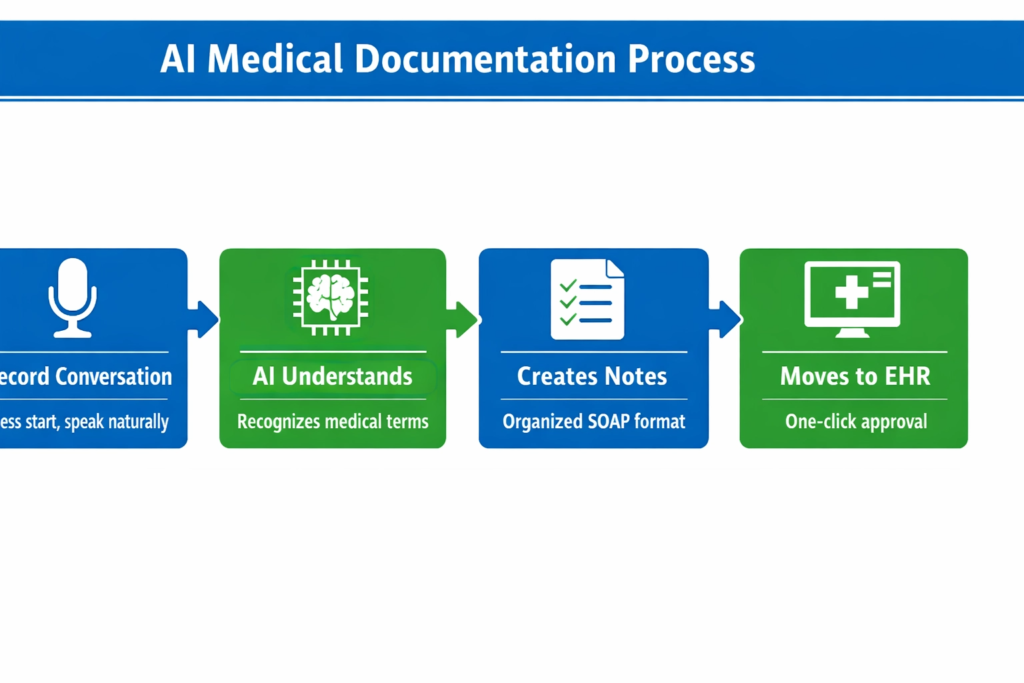
Step 1: Recording the Conversation
You press a button to start recording at the beginning of a patient visit. The software runs on your phone, tablet, or computer already in the exam room. No special equipment needed.
The system captures everything said while the appointment happens normally. Smart technology removes background noise like air conditioning, hallway sounds, and equipment beeps. It figures out who is speaking by recognizing different voices.
The technology correctly identifies speakers 96% of the time even when voices overlap or people have strong accents. It learns your speaking style over time and gets better with practice.
Step 2: Understanding Medical Language
The recorded audio gets converted into written text instantly. This is not regular speech recognition that gets confused by medical terms. This technology was trained specifically on medical conversations. It understands clinical vocabulary.
Drug names get written correctly. Anatomy terms make sense. Procedure names come out right. Diagnosis codes appear properly. Everything medical gets transcribed accurately.
But the AI does more than just write down words. It understands context. It knows what matters medically and what is just small talk. Weather chat gets filtered out. Weekend stories disappear. Only medical information moves forward.
The system recognizes medical concepts even when you speak casually. If a patient says “my stomach kills me after eating,” the AI understands this means upper abdominal pain after meals. When you say “let’s try a statin,” it knows you are prescribing cholesterol medication.
Comparing medical dictation vs medical scribe options shows why this approach beats older methods.
Step 3: Creating Organized Notes
The AI arranges all the medical information into proper note format automatically. Everything goes in the right section.
Subjective sections capture what patients say about their problems. Objective sections record vital signs, exam findings, and test results. Assessment sections summarize your diagnosis. Plan sections list prescriptions, referrals, tests, and follow up instructions.
The format matches what your specialty expects. Primary care notes emphasize prevention and chronic disease management. Emergency notes focus on decision making. Surgical notes highlight procedure details.
Leading systems create complete notes within 30 seconds after visits end. Some deliver documentation while patients still sit in the room.
Step 4: Moving to Your Records
Finished notes transfer directly into your electronic health record. Modern AI works with Epic, Cerner, Athenahealth, eClinicalWorks, and other major systems.
Direct connection pushes everything into the right fields automatically. You review and approve with one click. Even without automatic connection, the organized format makes copy and paste take only seconds.
Real Benefits You Will Notice Immediately
AI medical documentation changes your daily practice in ways you will feel from day one. These are not theoretical benefits. These are real changes that happen the moment you start using the technology.
Get Your Evenings and Weekends Back
Right now you probably spend 5 to 15 minutes typing notes after each patient visit. Multiply that across 30 patients and you lose hours every single day to documentation. Research shows doctors spend almost two hours on computer tasks for every hour with patients.
Studies on EHR documentation burden confirm this pattern affects physicians across all specialties and practice settings.
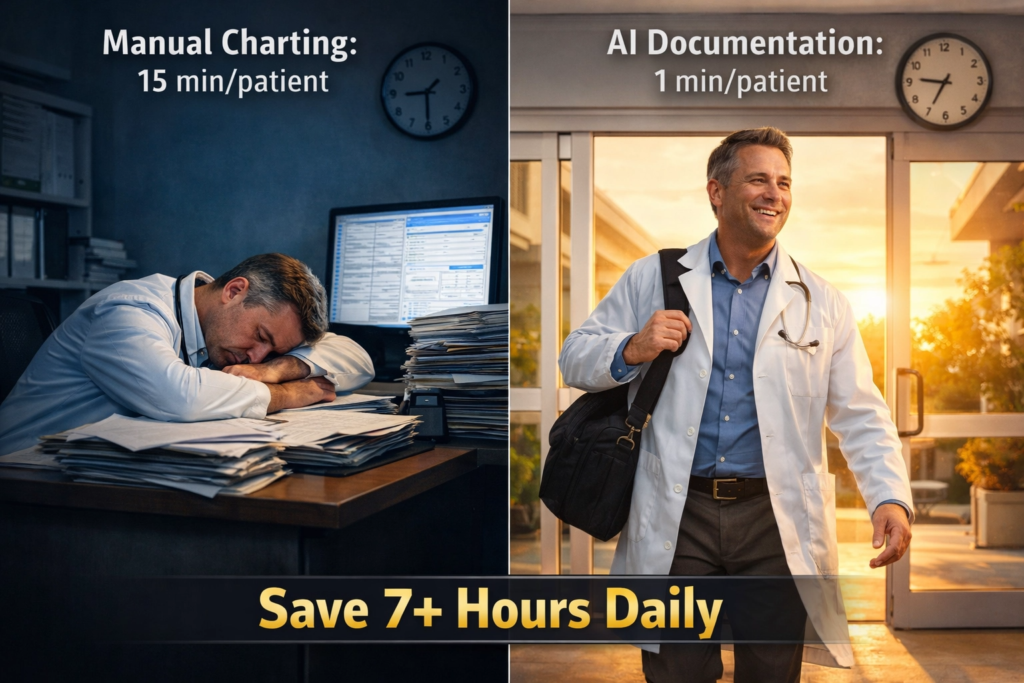
Most of this happens after work hours because charting between patients disrupts your flow. Evening sessions become routine. Weekend catch up feels normal. Vacation includes remote login time.
AI cuts that 5 to 15 minutes down to 60 seconds of quick review. The time savings add up incredibly fast. Seven minutes saved per patient across 30 daily visits equals 3.5 hours back to you. Over five days, that is 17.5 hours returned to your life.
These hours come back immediately. You leave work on time. Evenings belong to family. Weekends mean actual rest. Vacation is truly vacation.
Actually See Your Patients During Visits
Screen time during appointments damages relationships with patients. Everyone feels it. Typing while patients talk sends a clear message of divided attention. Looking at monitors instead of faces prevents real connection. Keyboard clicking creates barriers.

Patients notice this and hate it. Satisfaction scores prove it. Trust breaks down when technology gets more attention than the human sitting across from you. Important medical information gets missed when you focus on data entry instead of observation.
AI solves this completely. You maintain eye contact throughout entire visits. Conversations flow naturally. You catch body language and facial expressions. The healing relationship works the way it should.
Patient satisfaction jumps when you stop using computers during visits. Trust increases. Communication improves. Outcomes get better when you pay full attention.
Looking at the pros and cons of medical scribes shows how this technology compares to other solutions.
End the Constant Weight of Unfinished Work
Documentation workload drives burnout more than anything else. The endless charting creates a feeling that work never finishes. Tasks follow you home every night. Time off still includes documentation duties. Nothing ever ends.
This pattern slowly destroys mental health. Job satisfaction drops. Depression climbs. Early retirement starts looking attractive. Some doctors leave medicine entirely because paperwork makes practicing impossible.
AI stops this cycle instantly. Charts finish when patients leave. Nothing carries over to evenings or weekends. Vacation means actually disconnecting. The sense of completion returns.
Doctors report massive improvements in job satisfaction within weeks. Work life balance comes back. Mental health improves. Career satisfaction extends. The weight simply disappears.
Earn More Without Seeing More Patients
Time pressure makes you skip documentation details. Small elements do not make it into notes. Your charts fail to show all the work you actually do. This creates systematic under billing.
You perform complex medicine but bill simple rates because documentation does not support higher levels. This costs thousands monthly. Multiply across hundreds of yearly visits and the loss becomes huge.
AI captures every single detail. Nothing gets skipped. Every element that justifies appropriate billing gets documented completely. Your charts finally match your actual work.
Practices see immediate billing level increases after starting AI documentation. Average charges per visit rise. Revenue grows without adding patients. The technology pays for itself through billing accuracy alone.
Never Rely on Failing Memory Again
Writing charts from memory hours or days later guarantees mistakes. You forget medication names. Family history disappears. Similar patients get confused. Details mix between charts.
These errors create documentation that does not reflect actual visits. Future care gets based on wrong information. Legal risk increases when charts cannot prove what happened.
AI creates documentation the moment visits end. Every detail gets captured perfectly. No memory problems. Charts reflect exactly what just happened. Future doctors get reliable information. Legal defense becomes easier.
Different Ways to Get AI Documentation
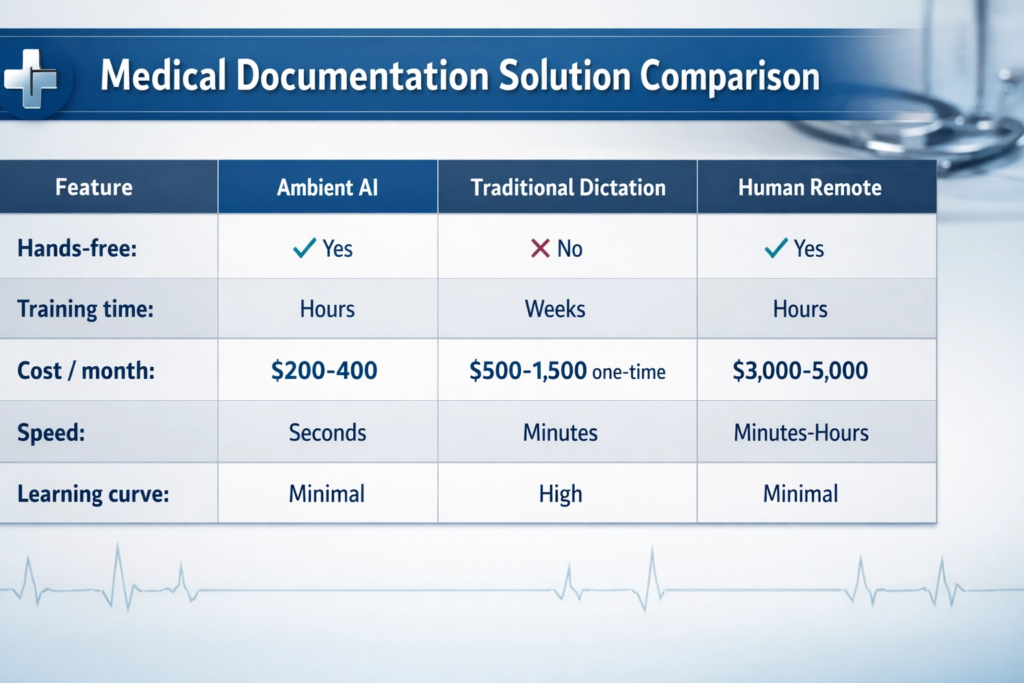
You have several options when choosing AI medical documentation. Understanding the differences helps you pick what works best for your practice.
Ambient AI (The Modern Solution)
This represents the newest and smartest technology. The system captures natural conversation without any special commands or speaking patterns. You talk normally with patients. The AI handles everything else automatically.
This works best if you want completely hands free documentation with almost no learning curve. The technology requires zero changes to how you normally practice beyond pressing start. Training takes a few hours. Setup runs about one to two weeks.
Monthly costs typically range from $200 to $400 per doctor for subscription plans. Some charge per visit instead. You get complete automation with minimal effort.
Traditional Dictation Software
These older systems require you to speak documentation explicitly with punctuation commands. The technology writes down your words but does not understand context or create organized notes automatically.
This works if you feel comfortable dictating everything explicitly. You need weeks to months of training. Electronic record navigation still requires manual work. The technology only handles text entry, not the thinking or organizing.
One time costs run $500 to $1,500 per license. You do the mental work of organizing. The software just types what you say.
Human Remote Assistants
Real people listen to your visits remotely and type documentation. These assistants work from secure locations. Quality depends on their training and experience.
This works if you prefer human understanding over AI. You get flexibility for unusual situations. However, quality varies by which person gets assigned. People call in sick. Staff turnover creates problems. Growth limitations exist.
Monthly costs range from $3,000 to $5,000 per doctor. High costs reflect ongoing salaries.
Mixed Approaches
Some systems use AI to create initial notes, then humans review and improve them. This tries to balance speed with quality checking.
These cost more than pure AI but less than pure humans. Speed falls somewhere in the middle. Quality tends toward better consistency.
Checking out the best AI medical scribe software helps you compare specific options and make smart decisions.
How to Actually Get Started
Starting AI documentation needs some planning but moves fast. Most practices finish setup within one month.
Picking What Works for You
Consider your specialty needs, electronic record compatibility, pricing, training requirements, and support quality. Primary care needs differ from emergency medicine or surgery. Make sure the platform handles your specific documentation.
Electronic record connection matters significantly. Automatic integration works far better than copy paste. Confirm connection capabilities before buying.
Request demonstrations with real patient scenarios. Test accuracy on your vocabulary. Judge quality against your standards. Include doctors who will actually use the system in the decision.
Setting Everything Up
Most platforms need minimal technical setup. Software installs on existing devices. Network requirements are usually just standard internet.
Electronic record connection varies by platform and system. Automatic connections may need IT help for setup and security approval. The AI company usually guides this process.
Security review should verify legal contracts, encryption standards, data deletion policies, and access controls. Compliance teams should approve before going live.
Learning the System
Training for modern systems is minimal. Most doctors become comfortable within hours. You just need to remember to press start, speak naturally, and review notes before approving.
Start with a small pilot group. Gather feedback. Fix any issues. Then expand to more users based on what you learned.
Expect 1 to 2 weeks of adjustment as you adapt. Documentation quality may vary at first as the system learns your voice. Accuracy improves rapidly with use.
What to Expect Timing Wise
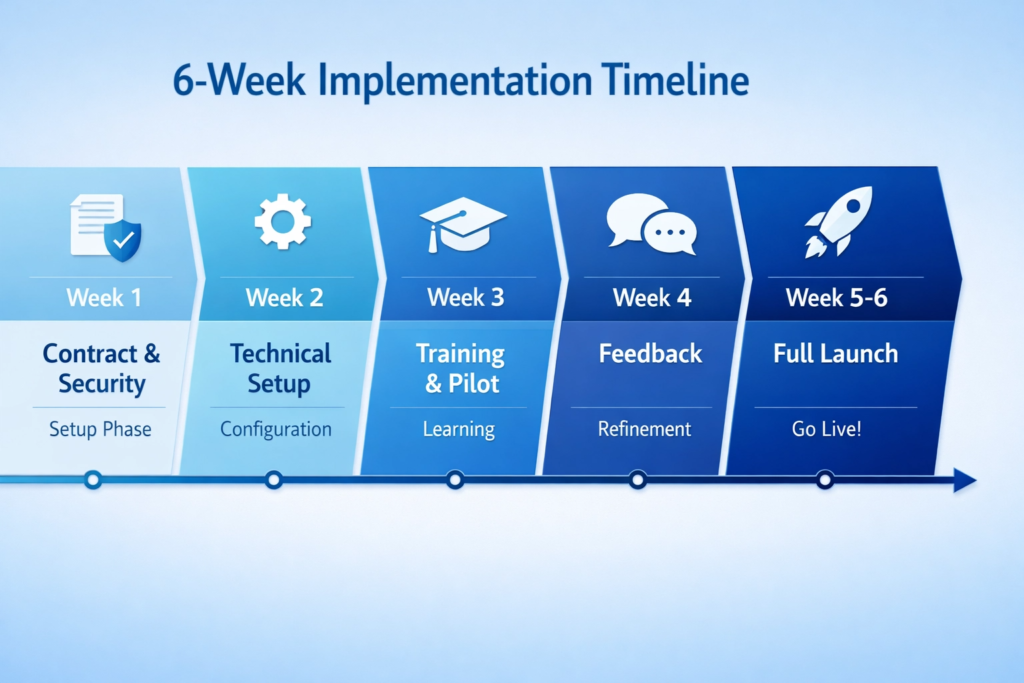
Week 1 covers vendor selection, contracts, and security review. Week 2 handles technical setup and record system connection. Week 3 includes training and pilot start. Week 4 focuses on feedback and improvements. Full launch usually finishes by week 5 or 6.
Plan for ongoing improvements after launch. Templates may need tweaks. Workflows may change. Support should fix problems quickly during the early phase.
Security and Privacy Protection
AI documentation follows the same strict rules as all healthcare technology. Understanding requirements helps you stay compliant and protected.
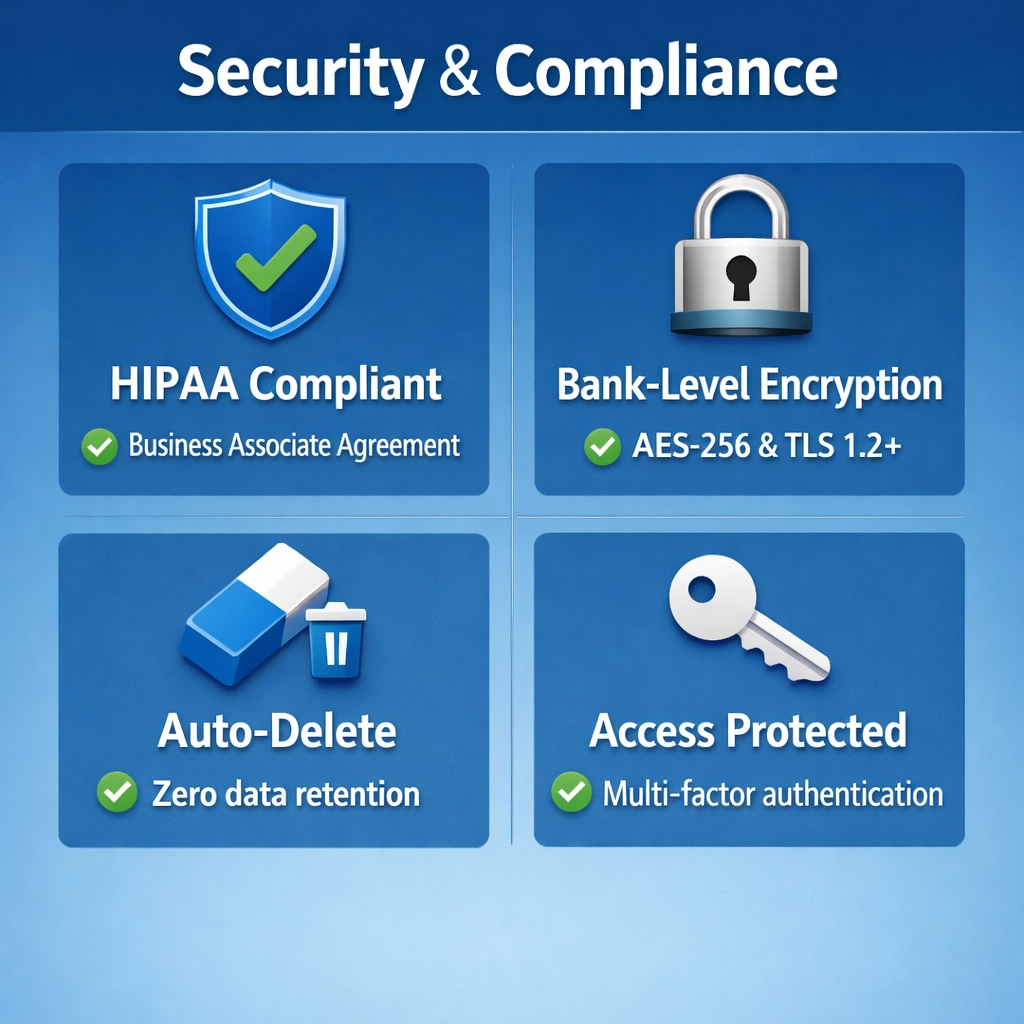
Legal Contracts That Protect You
Any AI vendor must sign a Business Associate Agreement. This legal contract makes them responsible for privacy law compliance. If breaches happen due to their security failures, they bear the legal and financial consequences.
Never use AI documentation without signed contracts. Verbal promises mean nothing legally. Only signed agreements create real protection.
Data Encryption
All patient data stays encrypted during sending and storage. Industry standard encryption prevents unauthorized access even if data gets intercepted or servers get compromised.
Check that platforms specify exact encryption methods. Vague claims suggest weak security. Good vendors document everything clearly.
Understanding HIPAA security requirements helps verify vendor compliance with privacy laws.
Automatic Data Deletion
Compliant vendors delete all patient data immediately after notes move to your system. Audio cannot stay on their servers. Information cannot train their AI programs.
Automatic deletion guarantees nothing continues beyond creating your documentation. Verify vendors enforce this and never keep data for any reason.
Access Controls
Proper security limits who can view documentation. Multiple step login prevents unauthorized access. Automatic timeouts protect unlocked devices. Activity logs track everything for compliance.
Implement controls in both AI platforms and record systems. Regular reviews should remove access for former staff. Security policies should enforce strong passwords and regular changes.
Learning about medical scribe duties and scope of practice explains legal boundaries around documentation assistance.
What It Really Costs and What You Really Get
AI documentation costs real money but delivers returns that far exceed the investment. Understanding both sides helps you make smart decisions.
What You Actually Pay
Monthly subscription costs typically run $200 to $400 per doctor depending on the platform and practice size. Yearly costs equal $2,400 to $4,800 per doctor. Some platforms charge per visit instead.
Setup costs include minimal IT time, brief training, and potential record system connection fees. Most practices complete setup without outside help.
Ongoing costs stay steady at monthly subscription levels. No surprise fees. No extra per visit charges. No staff expansion needed.
What Your Time is Actually Worth
Reclaiming 10 to 15 hours weekly creates enormous value. At average doctor pay of $200 per hour, 12 reclaimed hours weekly equals $2,400 in time value weekly. Over 48 working weeks, this becomes $115,200 yearly.
Even if only half converts to seeing more patients, the revenue impact dramatically exceeds software costs. Most doctors can see 2 to 3 more patients daily with reclaimed time. At $150 per visit, this creates $36,000 to $54,000 in additional yearly revenue.
How Revenue Grows
Better documentation raises average charges per visit by $15 to $25. Across 5,000 yearly visits, this creates $75,000 to $125,000 in additional revenue yearly.
Combined with increased patient volume, total improvement often exceeds $100,000 per doctor yearly. This provides 20 to 40 times return on investment.
Keeping Good Doctors
Doctor turnover costs $500,000 to $1,000,000 per departure including recruiting, training, lost productivity, and temporary coverage. If AI prevents even one departure over five years, the retention value exceeds all software costs.
Burnout reduction clearly improves retention. Job satisfaction increases. Career sustainability improves. Doctors stay longer when paperwork decreases.
Break even typically happens in 2 to 4 months considering only revenue and time savings. Including retention benefits makes the return overwhelming.
Common Questions About AI Documentation
Modern AI achieves 95% to 98% accuracy on medical terms. Accuracy varies slightly based on audio quality, speaking clarity, accents, and term complexity. Systems improve over time as they learn your voice. You always review before approving regardless of accuracy.
Most platforms connect automatically with Epic, Cerner, Athenahealth, and eClinicalWorks. Even without automatic connection, organized output makes copy paste take only seconds. Check specific compatibility during review.
Setup runs 7 to 30 days depending on practice size and system complexity. Small practices often finish in one week. Large systems may need 4 to 6 weeks. Training takes only hours. Learning lasts 1 to 2 weeks.
Federal laws generally allow recording medical visits for documentation without explicit agreement. However, state laws vary significantly. California, Illinois, Massachusetts, and several others require two party consent even in medical settings. Check your state laws before starting. Many practices post notices about recording
You review everything before approval. This catches errors before they enter records. Mistakes get fixed during review just like dictation or scribe errors. Most platforms allow editing within notes. Report serious or repeated errors to vendors.
AI handles routine and complicated cases equally well. Technology captures all conversation regardless of complexity. Quality depends more on conversation completeness than difficulty. Discuss all relevant details out loud. As long as information gets spoken, AI captures it properly.
Compliant platforms protect information through legal contracts, encryption, automatic deletion, and access controls. Recordings get encrypted immediately. Processing happens on secure servers. All data gets deleted after moving to your system. Nothing stays on vendor servers. Nothing trains public programs.
Most platforms store recordings locally if internet drops. Documentation uploads when connection returns. Some offer offline processing without internet. Check offline capabilities if connection concerns exist.
Yes, AI works for both in person and telemedicine visits. Platforms capture audio from video systems the same way they capture in person conversations. Some connect directly with telemedicine software. Others need separate audio capture. Check compatibility if virtual visits represent significant volume.
Ready to Get Your Life Back?
You became a doctor to help patients, not to click through electronic forms and type notes until midnight. AI medical documentation gives you back what medicine took away: your time, your energy, and your connection with patients.
Imagine finishing your last appointment of the day with all charts complete. Walking out on time. Eating dinner with family. Sleeping without charts hanging over you. Enjoying weekends without documentation homework. Taking actual vacation without remote logins.
This is not a fantasy. This is what happens when technology handles documentation automatically while you focus completely on practicing medicine.
Why Choose ScribeRunner
We built ScribeRunner specifically for physicians who want their lives back. Our ambient AI captures every clinical detail while you maintain full attention on patients. Notes appear formatted and ready before the next appointment starts.
No complicated setup or long training programs. No confusing interfaces or technical problems. No long term contracts or commitments. Just simple technology that works the way you need it to work.
Most doctors cannot imagine going back to manual documentation after experiencing the difference. Charts that once took 10 minutes now take 60 seconds. Evenings that once belonged to the EHR now belong to family. Work that once felt crushing now feels sustainable.
What Makes Us Different
We understand medicine because we lived it. Our technology was built by healthcare professionals who experienced the documentation problem firsthand. We know what doctors need because we have been there.
Complete notes in seconds, not hours. Our AI captures everything while you stay focused on patients. Implementation happens fast, usually within one week. Our team handles technical details so you can start immediately.
No long commitments required. Try ScribeRunner and cancel anytime if it does not transform your practice. Bank level security protects everything with HIPAA certification and automatic data deletion.
Start This Week
See exactly how it works in a free demonstration using your specialty vocabulary. Watch complete patient encounters transform into finished notes within seconds. Get honest answers about your specific workflow and needs.
📞 Call us at (786) 866-7849
Monday through Friday, 8 AM to 6 PM Eastern
Based in Miami, serving practices nationwide
Stop charting at midnight. Start living again. Give yourself back the time medicine took away.