
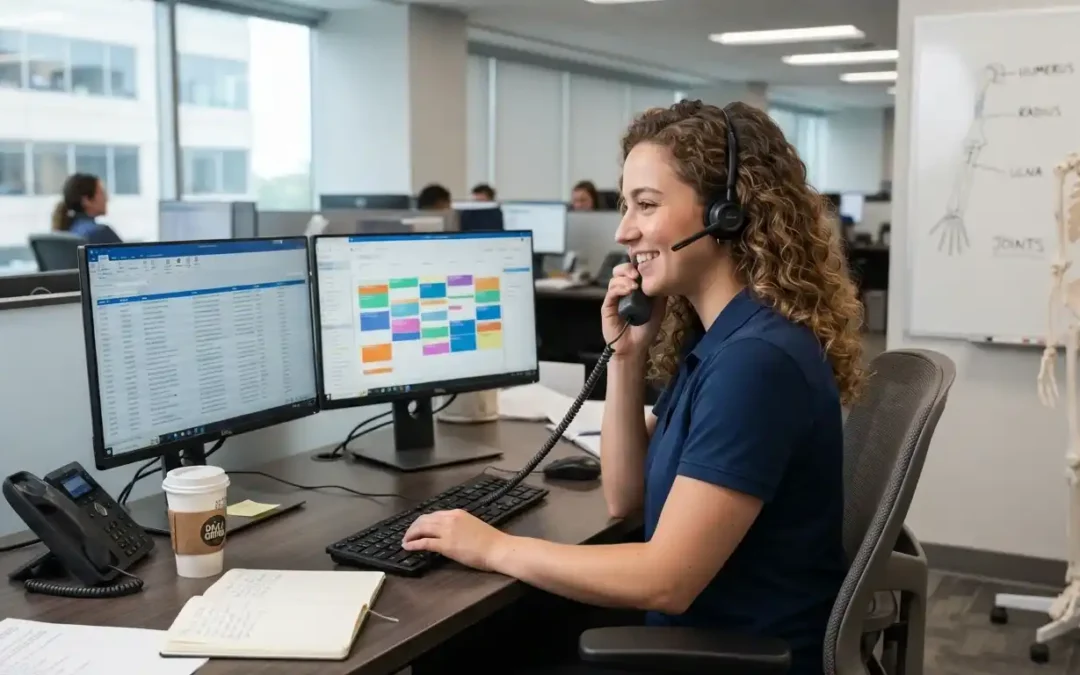
An orthopedic answering service manages incoming patient phone calls during after-hours, lunch breaks, or high-volume peak periods, ensuring acute clinical needs and administrative tasks are processed without overwhelming front-desk staff. Unlike generic call centers, these specialized services utilize HIPAA-compliant systems, clinical escalation protocols, and electronic health record (EHR) integrations designed specifically for musculoskeletal care, joint practices, and orthopedic surgery centers.
What is an Orthopedic Answering Service?
An orthopedic answering service is a specialized healthcare communications bridge that manages patient calls around the clock. It separates urgent orthopedic emergencies (like acute fractures or severe post-op pain) from routine administrative requests (like appointment booking or prescription refills) using clinical triage protocols.
Ortho calls don't behave like a typical primary care line. On any given afternoon you've got a scheduled knee-replacement follow-up, a weekend warrior who just heard a pop in his ACL, and a post-op patient whose incision looks "weird." Different urgency, different handling, same phone queue.
So what happens when nobody answers? Two things - and honestly, only one of them is dangerous.
- Missed clinical warning signs. A patient three days out from surgery calls with swelling, fever, or pain that's suddenly worse, hits voicemail, and just waits. That's the gap where DVTs, infections, and compartment syndrome quietly turn into an ER visit.
- Lost patients. Someone with a fresh sports injury doesn't leave a voicemail they call the ortho group down the street.
A good answering service closes both gaps. Whether it's a HIPAA-trained human, an AI voice agent, or more often lately both working together, the call gets picked up immediately, triaged against rules your clinic set, logged into the chart, and, if it's actually urgent, the on-call surgeon gets paged. Not "someone will call you back within 24 hours." Now.It's essentially an extension of your scheduling department, just one that never clocks out and it works hand in hand with virtual receptionists covering the rest of the front desk.
Step-by-Step: How an Orthopedic Answering Service Operates
Strip away the marketing language and it comes down to five stages: the call gets routed in, it's triaged for clinical risk, it's booked or logged directly into the EHR, anything urgent gets escalated to the on-call surgeon, and your team gets a report waiting for them in the morning so nothing falls through overnight.
[Patient Inbound Call]
       │
       ▼
[Instant Forwarding (No Menu / Zero Hold)]
       │
       ▼
[Triage Protocol Evaluation]
 ┌─────┴─────────────────────────────────────────┐
 │                                               │
 ▼                                               ▼
[Routine Inquiry]                               [Urgent Clinical Incident]
 ├─ Schedule/Reschedule in EHR                   ├─ Capture Patient Symptoms
 ├─ Log Prescription Request                     ├─ Send Secure Encrypted Alert
 └─ Deliver Morning Summary                      └─ Connect On-Call Orthopedist
Step 1: The Call Gets Rerouted, Instantly
Clinic closes, lunch hits, or three lines light up at once the phones route over to the answering service automatically. Caller doesn't notice a thing. One or two rings, and someone (or a voice AI trained to sound like someone) picks up in the practice's name.
Step 2: Triage Urgent or Not
Every clinic sets its own script for this, but it boils down to sorting calls fast into two buckets.
Most calls are the boring kind a referral request, someone asking about their MRI slot, a billing question, a refill. Handle it, log it, move on.
Then there's the other kind. Bleeding that hasn't stopped. Sudden numbness. A cast that's suddenly too tight. Pain that's way past what it should be at this point in recovery. Those don't wait for the morning shift.
Step 3: It Actually Books the Appointment
This is where it stops being a glorified voicemail. Decent services plug directly into whatever you're already running Epic, Athenahealth, ModMed, eClinicalWorks and read the live schedule. So instead of "we'll call you back," the patient hangs up with an actual appointment on the calendar. Rescheduled, cancelled, booked done in the call.
Step 4: The On-Call Surgeon Gets Paged, Not Emailed
Anything flagged urgent goes straight to whoever's on call text, encrypted push, or an actual phone call, depending on how the practice set it up. And it's not just "patient called, sounds bad." The surgeon gets the real context: what was said, what the symptoms were, so they're not walking in blind.
Step 5: Morning Comes, Nothing's Missing
Every call from overnight the routine ones, at least gets transcribed and dropped straight into the EMR inbox. So when the front desk shows up at 8am, they're not digging through sticky notes. There's a clean log: who called, what happened, what got booked.This is the same principle behind clinical documentation specialists nothing sits unrecorded overnight.
Live-Agent vs. AI-Powered Orthopedic Answering Services
Traditional answering services utilize live human operators who record messages and page staff, whereas modern AI-powered services handle end-to-end tasks like direct EHR booking and automated triage with zero hold times.
| Feature | Traditional Live Answering Service | Modern AI-Powered Medical Service |
| Response Time | 3 to 5 rings; potential hold queues during peak hours | Instant answer on the 1st ring; zero hold time |
| Task Capability | Primarily takes messages and relays callbacks | Complete end-to-end actions (direct scheduling, cancellations, triage) |
| EHR Integration | Manual transcription into portal or morning email delivery | Real-time bi-directional synchronization with Epic, Athena, ModMed |
| Call Capacity | Limited by available human call agents per shift | Unlimited concurrent calls handled simultaneously |
| Language Support | Subject to agent availability; often requires translation delays | Instant multi-language support (e.g., 20+ languages dynamically) |
| Cost Structure | Charged per minute ($0.85–$1.75/min) or per message plus holiday surcharges | Flat monthly rate or low per-interaction cost with no holiday surcharges |
Core Workflows Handled by Orthopedic Answering Systems
Specialized services streamline five main administrative and clinical areas: post-surgical monitoring, acute injury intake, live appointment scheduling, prescription management, and multi-channel outreach.
┌────────────────────────────────────────────────────────────────────────┐
│                      Orthopedic Service Workflows                      │
└────────────────────────────────────────────────────────────────────────┘
     │            │                     │                    │
     ▼            ▼                     ▼                    ▼
[Post-Op Triage] [Injury Intake]    [EHR Scheduling]   [Refill Management]
 - Infection     - Sports Trauma     - Pre-op consults  - Anti-inflammatories
 - Hardware      - Acute Fractures   - Therapy slots    - Pain management
 - Numbness      - Joint Pain        - MRI follow-ups   - Physical therapy
1. Post-Surgical Emergency Triage
Anyone who's had a total knee replacement, rotator cuff repair, or spinal fusion knows the first two weeks are a minefield of "is this normal?" A decent answering service knows the difference between normal soreness and a real red flag excessive drainage, swelling that's spreading, numbness, pain that pain meds aren't touching and gets those straight to the surgical team instead of leaving someone to Google it at 2am.
2. Sports Injuries Can't Wait for Monday
Somebody tears something on a Saturday, they're not calling to leave a message. The service pulls the actual mechanism of injury out of them was it a direct hit, did the knee hyperextend, did they hear a pop and gets them into a same-day or next-day slot instead of a routine callback.
3. Scheduling the Part That Actually Eats Your Front Desk's Day
This is the unglamorous one, but it's probably the biggest time sink: rescheduling, cancellations, follow-up spacing rules between surgery dates. A good system handles all of it directly against the calendar including grabbing last-minute openings the second someone cancels, instead of that slot sitting empty.
4. Refills and Therapy Extensions
Pain med refill, PT extension request sounds simple, but it still needs the pharmacy checked, the med history verified, before it ever lands in front of the physician. The service does that legwork first, so what hits the EMR queue is already ready to sign off on, not a half-finished request.
Primary Benefits for Orthopedic Practices
Cut through the compliance-speak and it comes down to four things: fewer patients slipping away, a front desk that isn't drowning, safer post-op patients, and nobody worrying about a HIPAA violation.
- Patients stop disappearing. Nearly a third of first-time callers who hit voicemail just hang up and call someone else. That's not a missed message - that's a surgical consult walking straight to a competitor.
- Your front desk actually breathes. Ask anyone up front what mornings feel like and "call queue" comes up before anything else. Take that off their plate and check-ins stop getting interrupted every few minutes.
- Post-op patients get caught earlier. Swelling or numbness spotted on day three instead of day seven that's the difference between a phone call and a 30-day readmission.
- Compliance stops being a gray area. A general call center running your lines is a liability waiting to happen. A real medical answering provider works under a signed BAA with PHI encrypted end to end no gray area.
Orthopedic Answering Service Pricing Models
Most services fall into one of three pricing setups per minute, per call, or a flat monthly rate. Which one makes sense depends a lot on how many after-hours calls your practice actually gets.
| Pricing Model | Average Cost Range | Best Suited For | Key Considerations |
| Per-Minute Billing | $0.85 – $1.75 / minute | Small practices with low after-hours volume | Invoices fluctuate; hold times and long clinical calls increase costs. |
| Per-Call Billing | $0.75 – $1.50 / call | Practices needing coverage only for overflow periods | Cost is predictable per call, but wrong numbers or quick hang-ups are still charged. |
| Flat-Rate / AI Subscription | $199 – $1,500 / month | Mid-to-large practices, high-volume joint clinics | Fixed monthly cost with unlimited calls and zero after-hours or holiday surcharge |
Frequently Asked Questions
What happens if someone calls in with a real post-surgical emergency?
It comes down to whatever triage rules your clinic set up ahead of time. Fever, bleeding that hasn't stopped, numbness, pain way past what it should be any of that trips the urgent protocol, and the on-call surgeon gets an encrypted alert plus a direct line to the caller, not a message sitting in a queue.
Does it actually talk to Epic or ModMed, or just take a message?
It actually talks to them. A real medical answering platform reads live provider schedules, books or moves appointments, and drops the call transcript straight into the chart no one manually re-typing anything the next morning.
Is this actually HIPAA compliant, or just "HIPAA-adjacent"?
A legitimate one is signed BAA, SOC 2 servers, encrypted call logs. Worth double-checking before you sign anything, though, because plenty of general answering services will say "HIPAA compliant" without actually backing it with a BAA.
What about patients who don't speak English?
Most decent platforms cover this now, either with bilingual live operators or AI that handles Spanish, Mandarin, French, and a few others fluently. Nobody should be getting worse care because of a language gap.
At the end of the day, the pitch is simple: a good orthopedic answering service catches the emergencies that can't wait, keeps your front desk from drowning in call volume, and turns after-hours calls into booked visits instead of lost patients. Get the triage rules, the EMR integration, and the on-call escalation right, and the phones stop being the weak point in your practice.