

Ambient Clinical Intelligence (ACI) is an advanced healthcare technology that uses artificial intelligence, natural language processing (NLP), and speech recognition to passively capture doctor-patient conversations during clinical visits. It automatically translates free-flowing dialogue into structured, medical-grade documentation within Electronic Health Records (EHRs), eliminating manual typing, reducing physician burnout by up to 40%, and allowing doctors to focus entirely on patient care.
Comparison of Leading Ambient Clinical Intelligence Platforms
Before looking at how the technology works, here is how top Ambient Clinical Intelligence tools compare on key clinical metrics:
| Platform | Setup Time | Pricing Model | Specialty Customization | EHR Integration | Primary Best Fit |
| ScribeRunner | Instant (Minutes) | Affordable Flat Rate | High (Learns Provider Style) | Universal / Web Extension | Solo, Small & Mid-Sized Practices |
| Nuance DAX | Weeks to Months | High Enterprise ($800+/mo) | Moderate (Template-based) | Deep Epic / Cerner | Large Hospital Systems & Enterprise |
| Abridge | Weeks | Mid-to-High Tier ($200+/mo) | Moderate | Deep Epic Focus | Compliance-Driven Health Systems |
| DeepScribe | 1–3 Weeks | Premium Tier ($700+/mo) | High (Complex Specialties) | Athena, Epic, eCW | Specialty Practices (Cardiology, Oncology) |
| Freed AI | Minutes | Low Tier ($84/mo) | Low to Moderate | Browser Push / Copy | Solo Practitioners & Micro-Clinics |
What is Ambient Clinical Intelligence and How Does It Work?
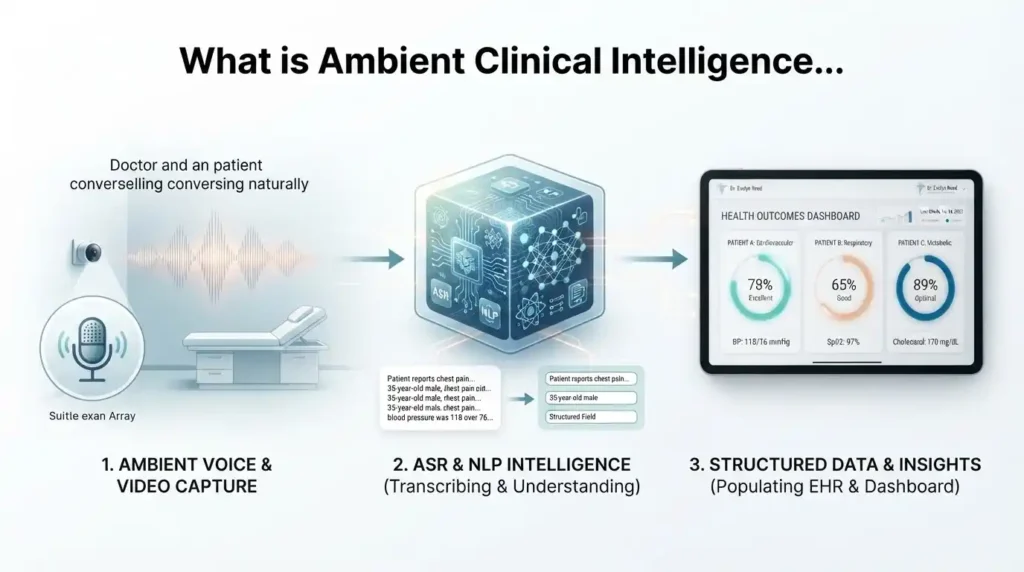
Ambient Clinical Intelligence is a speech-activated AI technology that listens in the background of a medical visit. It extracts medical facts from natural doctor-patient dialogue and automatically constructs structured SOAP notes, coding suggestions, and treatment plans in real time, freeing physicians from typing during exams or staying late to complete charts.
Understanding the Mechanism Behind Ambient AI
For years, writing medical notes meant typing continuously on a computer or speaking into a handheld microphone. Doctors had to look away from the patient to enter data. Ambient Clinical Intelligence changes this by moving from active typing to quiet listening.
When turned on using a phone, tablet, or desktop, the ambient tool listens silently. Old dictation software required users to say words like "comma," "period," or "new paragraph." Ambient AI is different. It tells the difference between everyday conversation ("How are your kids?"), medical history ("My knee hurts when I walk up stairs"), and current symptoms.
[ Ambient Microphone Input ]
          │
          ▼
[ Acoustic Speech Recognition (ASR) ] ➔ Filters background noise & accents
          │
          ▼
[ Natural Language Processing (NLP) ] ➔ Extracts clinical facts & intent
          │
          ▼
[ Generative Large Language Model ]  ➔ Constructs formatted SOAP notes
          │
          ▼
[ EHR Integration / Direct Push ]   ➔ Populates chart for provider review
The system uses three main tech steps:
- Speech Recognition: It cleans up background room noise, separates the doctor's voice from the patient's voice, and understands medical terms spoken in different accents.
- Language Understanding: It finds the core medical facts. For example, it knows the difference between "I had surgery 3 years ago" and "my pain started 3 days ago."
- Note Building: It uses medical AI to organize those facts into standard medical note sections, such as Subjective, Objective, Assessment, and Plan (SOAP) notes.
Practices looking to streamline their daily paperwork can check out ScribeRunner’s Ambient AI Features to see how passive audio capture works during real visits.
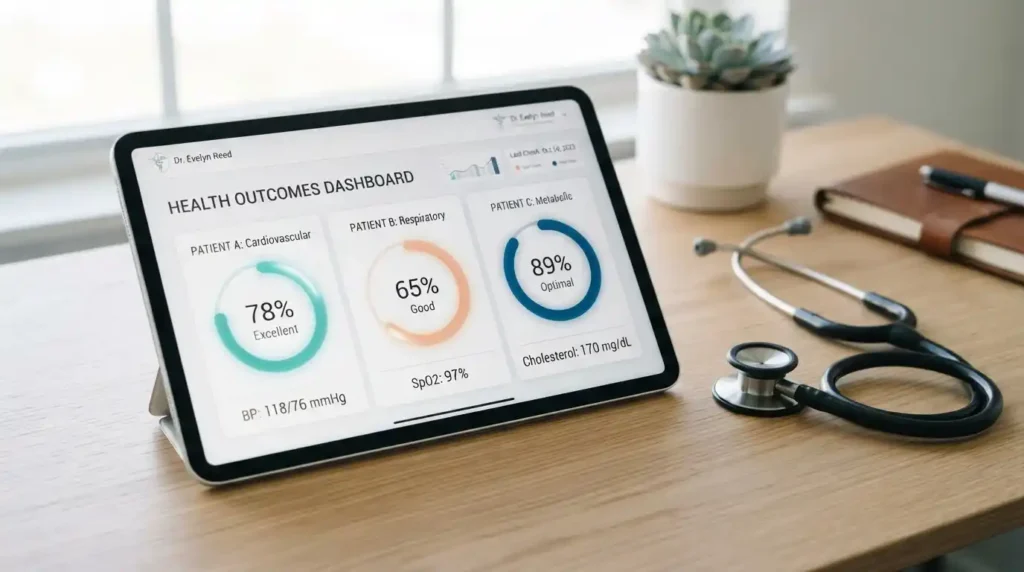
Key Benefits of Ambient Clinical Intelligence in Modern Healthcare
Implementing Ambient Clinical Intelligence reduces physician burnout by cutting documentation time by up to 70%. It improves eye contact with patients, speeds up chart completion, improves note accuracy for billing, and helps clinics see more patients each day without needing extra administrative staff.
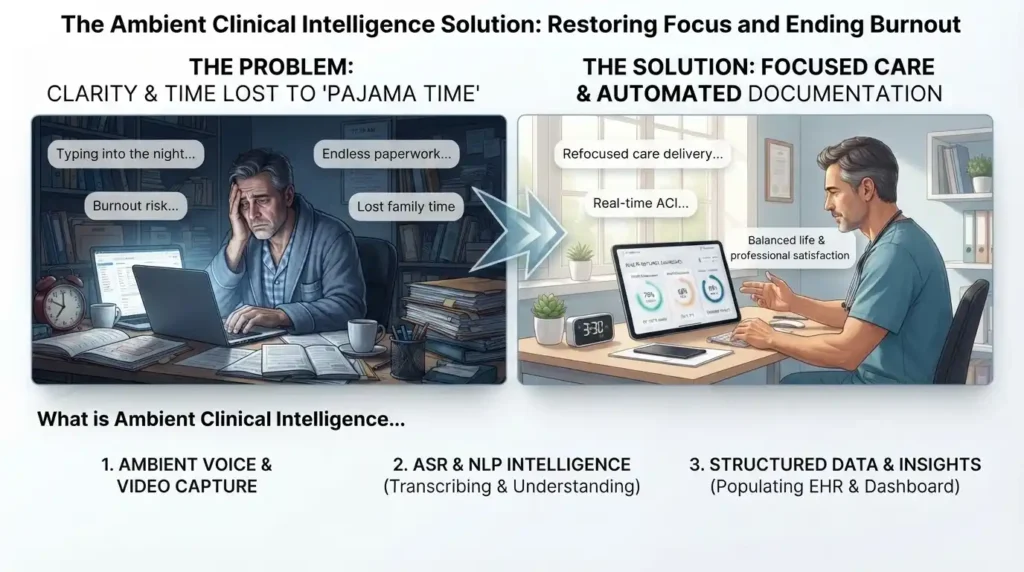
1. Stopping "Pajama Time" and Provider Fatigue
Too much paperwork is the primary cause of doctor fatigue and stress. Many physicians spend two hours doing computer work for every one hour they spend with patients. This work often carries over into the evening—a problem known as "pajama time."
With Ambient Clinical Intelligence, medical notes are built right as the visit happens. Doctors can check and sign their notes before going home, giving them back their evenings and reducing overall work stress.
2. Focus on Patients Instead of Screens
When doctors type on laptops during visits, patients feel ignored. Ambient Clinical Intelligence keeps technology in the background. Doctors can look their patients in the eye, listen closely, and build trust while the software handles note-taking.
3. Clearer Notes and Accurate Medical Billing
Writing notes from memory at the end of a long day can cause missed details. Ambient AI captures the complete conversation as it happens. It records symptoms, social history, and care plans accurately. This detail supports proper medical coding (ICD-10 and CPT codes) so clinics get paid correctly for the care they provide.
To see how much time and money your clinic could save, try the ScribeRunner ROI Calculator.
Core Features to Look For in an Ambient AI Scribe Platform
Essential features of top Ambient Clinical Intelligence software include real-time note generation, custom clinical formatting, multi-language support, seamless EHR compatibility, and enterprise-grade security (HIPAA/SOC-2). Advanced platforms also learn provider writing styles over time and provide automated medical coding recommendations.
1. Flexible Formatting and Custom Styles
Every doctor writes notes a bit differently. An eye doctor needs short, specific bullet points, while a family doctor needs longer story-style notes. A good Ambient Clinical Intelligence system lets doctors create custom note templates that match their personal style.
2. Simple EHR Connection Options
Connecting easily to your current chart software is very important. Some big hospital tools require months of IT setup. Modern cloud tools like ScribeRunner use web extensions and quick copy tools that work right away on web-based EHRs (like Athenahealth, Practice Fusion, or DrChrono).
3. Strong Data Security and HIPAA Protection
Because these tools handle private medical records, privacy is essential:
- Strong data encryption while data travels and while stored.
- Deleting audio recordings immediately after the note is finished.
- Signing official HIPAA security agreements (BAA).
How to Implement Ambient Clinical Intelligence in Your Medical Practice
Implementing Ambient Clinical Intelligence requires selecting an intuitive AI scribe, establishing patient consent protocols, training clinical staff, and testing workflows in daily visits. Most modern cloud-based systems deploy within minutes without heavy IT overhead, enabling providers to adapt rapidly and achieve immediate documentation efficiency gains across primary care and specialized settings.
[ Step 1: Audit Workflows & Select Tool ]
          │
          ▼
[ Step 2: Set Consent & Privacy Steps ]
          │
          ▼
[ Step 3: Quick Setup & Template Sync ]
          │
          ▼
[ Step 4: Test on Visits & Fine-Tune ]
          │
          ▼
[ Step 5: Full Daily Practice Use ]
1. Reviewing Your Clinic Needs
First, look at how your clinic creates notes today. Small private clinics usually want simple, web-based tools that start working in minutes. Larger hospital networks often require deep software connections. Pick a tool that fits your note layout with minimal manual typing needed afterward.
2. Setting Simple Patient Consent Steps
Patients are happy to let AI listen when they learn it helps their doctor pay full attention to them.
- Simple Spoken Consent: "I use an AI helper today to take notes so I can focus on listening to you. Is that okay?"
- Simple Room Signs: Small notices explaining that voice audio is processed securely to create charts and is never saved permanently.
3. Easy Staff Onboarding
Unlike old medical software that takes weeks to learn, modern Ambient Clinical Intelligence tools are very simple. Doctors need just 15 to 30 minutes to set up their note preferences. After 3 to 5 visits, doctors feel comfortable talking naturally while the AI creates the note.
Check out ScribeRunner's Simple Setup Guide to see how easy it is to start.
Specialty-Specific Use Cases for Ambient Clinical Intelligence
Ambient Clinical Intelligence adapts seamlessly across diverse medical specialties, including primary care, cardiology, psychiatry, urgent care, and orthopedic surgery. The technology accurately processes specialized terminology, complex diagnostic reasoning, and multi-system physical exams while tailoring output formats to match the unique documentation standards of each discipline.
Primary Care and Family Medicine
Primary care visits cover many topics at once like high blood pressure, diabetes, and lifestyle advice. Ambient AI separates casual conversation from medical facts, creating clear notes with updated prescriptions and treatment steps.
Mental Health and Psychiatry
Psychiatry sessions depend on strong personal connection. Ambient scribes write down session details without requiring the therapist to type or take notes during the conversation. The AI formats progress notes cleanly while keeping the doctor focused on the patient.
Urgent Care Clinics
Urgent care clinics move very fast. Providers use ambient tools on mobile phones or tablets to record notes quickly between rooms. Notes are ready right away, helping clinics treat patients faster without paperwork delays.
Surgical and Specialized Care
Surgeons use clear, specific medical terms for joint moves, heart tests, or surgical plans. Ambient Clinical Intelligence understands complex medical language and organizes assessment and plan sections accurately for specialty billing.
Overcoming Common Challenges and Misconceptions
While concerns around AI accuracy, security, and patient privacy exist, modern Ambient Clinical Intelligence mitigates these risks using specialized medical LLMs, strict HIPAA compliance, and provider-in-the-loop verification. The clinician retains full control, reviewing and editing every note before signing and finalizing it within the Electronic Health Record.
Myth 1: The AI will make up false medical facts.
Basic consumer AI tools sometimes make mistakes, but medical AI models are built to use only the real spoken audio. Ambient tools match created notes directly to what was said in the room. Most importantly, the doctor is always in control—they review, edit, and approve every note before signing.
Myth 2: The system keeps and saves patient voices forever.
Privacy rules under HIPAA are strict. Ambient AI tools process voice audio in secure temporary memory and delete the audio right after the text note is built. Audio is not kept, shared, or sold.
Myth 3: Background noise ruins the notes.
Modern microphone tools filter out room noise easily. The system ignores noise like crying babies, hallway sounds, or moving papers. It also knows who is speaking the doctor, the patient, or a family member.
Learn more about privacy and security at ScribeRunner’s HIPAA Compliance Center.
Key Trends Shaping Ambient AI in 2026 and Beyond
In 2026, Ambient Clinical Intelligence is evolving beyond basic documentation into proactive clinical decision support. Emerging trends include multi-lingual real-time translation, automated coding optimization, predictive clinical alerts during visits, and seamless multi-modal AI integration that analyzes both voice dialogue and physical exam imagery simultaneously.
1. Live Multi-Language Translation
Language barriers can make patient care difficult. New ambient tools can listen to a visit in languages like Spanish, French, or Chinese and write the final medical note in clean, standard English in real time.
2. Automatic Medical Coding Help
Ambient systems now do more than write notes. They check the notes against billing rules and suggest the correct ICD-10 and CPT codes. This helps clinics avoid billing mistakes and get paid correctly for their work.
3. Real-Time Clinical Suggestions
Modern ambient software acts like a smart clinical assistant. As the doctor and patient talk, the software can bring up clinical guidelines or flag potential medicine warnings right on the screen before the patient leaves.
Frequently Asked Questions (FAQs) About Ambient Clinical Intelligence
1. Does Ambient Clinical Intelligence store patient voice recordings?
No. Secure ambient AI scribes process voice sound temporarily to make the note. Once the note is ready for the doctor, the audio file is deleted immediately to keep patient data completely safe.
2. Does Ambient Clinical Intelligence work with my EHR software?
Yes. Enterprise options connect to systems like Epic or Cerner, while modern solutions like ScribeRunner work with any web-based or desktop EHR such as Athenahealth, Practice Fusion, eClinicalWorks, or DrChrono using web extensions or quick copy actions.
3. How long does it take for a doctor to learn how to use it?
Most doctors learn to use ambient AI in 1 to 3 days. Because you talk normally to your patient without saying special dictation commands, using the system feels completely natural.
4. How does ambient AI handle noise or extra people in the room?
Ambient systems use smart voice isolation technology. They separate the doctor's voice from the patient's voice and ignore background noise like room fans or hallway sounds.
5. What is the difference between dictation and Ambient Clinical Intelligence?
With traditional dictation, doctors must stop after the visit and speak directly into a microphone, dictating punctuation line by line. Ambient Clinical Intelligence is passive: it listens to the natural visit as it happens and creates a organized note automatically.
Conclusion: Transform Your Clinical Workflow with ScribeRunner
Ambient Clinical Intelligence is changing how modern healthcare practices handle documentation. By eliminating manual typing and evening charting, ambient AI restores the human connection in medicine, reduces provider burnout, and improves documentation thoroughness giving clinicians back hours of valuable time every single day.
Heavy paperwork should not take away your time with patients. Ambient Clinical Intelligence gives you a clear way to finish your notes quickly, end your work day on time, and focus on delivering great medical care.
Whether you run a small clinic or a larger specialty practice, starting with hands-free documentation is fast and easy.
Ready to Save 2+ Hours Every Single Day?
Try effortless ambient documentation today with ScribeRunner.
- Fast Setup: Get started in less than 5 minutes on any web browser or mobile device.
- Universal EHR Compatibility: Push notes easily to Athenahealth, Epic, Cerner, Practice Fusion, and more.
- HIPAA Compliant & Secure: Industry-standard encryption with zero permanent audio saving.
👉 Join ScribeRunner Today and experience hands-free note-taking during your very next patient visit.