
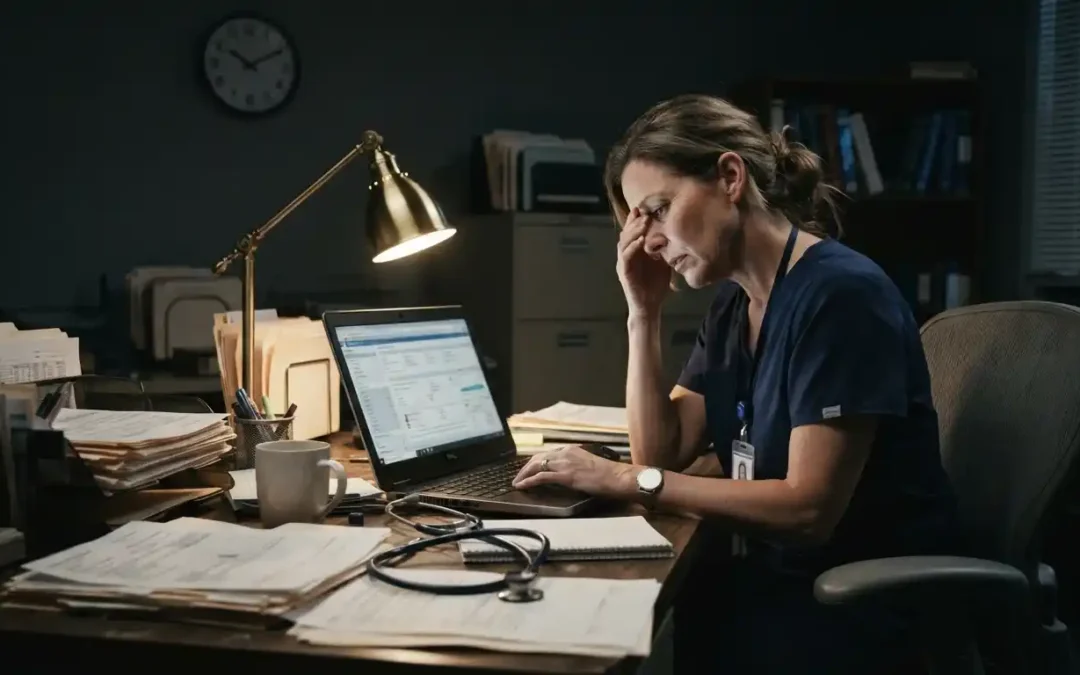
Live vs asynchronous virtual scribes are usually presented as the only two options when a practice decides to outsource documentation. One gets a scribe on the call in real time, the other hands off a recording to be documented later. Both promise the same thing: less charting, more time with patients.
But here's the catch. Neither model is actually built to solve the whole problem. Live scribing gets you speed, but it costs more and depends entirely on one person keeping pace, visit after visit, all day. Asynchronous scribing costs less, but you're stuck waiting for someone else's queue before your chart is ready. Pick one, and you're still trading one problem for another.
That's exactly why we didn't build ScribeRunner around either model. Instead of forcing you to choose between speed and cost, our AI-plus-human hybrid approach delivers both — charts closed in hours, not days, without sacrificing accuracy or driving up your bill. In this article, we'll break down how live and asynchronous scribing actually work, where each one falls short, and why the real answer for most practices isn't picking a side. It's skipping the tradeoff altogether.
Solving the Paperwork Problem : Live vs Asynchronous Virtual Scribes
If you're a physician, you already know the drill. EHR requirements keep piling up, compliance checklists keep growing, and somehow there's less time left for the thing you actually trained to do: see patients. Physician burnout tied to administrative overload remains one of the biggest challenges in modern medicine, and the choice between a live vs asynchronous virtual scribes has become one of the most practical ways to fix it. Either option means letting someone else handle the note-taking while you focus on the exam room.
For years, that's meant choosing between two human-only models: live scribing, where someone documents your visit as it happens, and asynchronous scribing, where a recording gets documented afterward. Both work. Both also come with tradeoffs that neither one really escapes, which is part of why we built ScribeRunner's Virtual Medical Scribe Service around a different model entirely. Let's walk through how each one works, then get into what changes when AI enters the picture.
Live scribing: someone's on the call with you
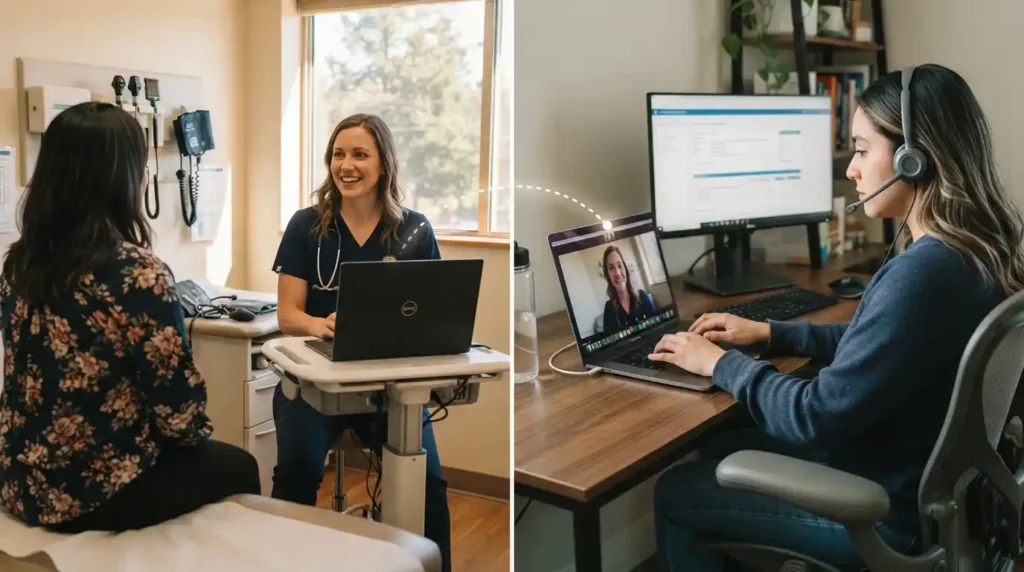
With live scribing, a scribe joins your patient encounter - by phone or video - and writes everything down as it's happening. By the time you hang up, the note is basically done.
The appointment gets scheduled as normal, the scribe joins with the patient's consent, and while you're talking through history, symptoms, your assessment, and the treatment plan, they're documenting all of it in real time. Once the visit wraps, you look over what they wrote, make any tweaks, and sign off.
This tends to work best in places where speed matters , emergency departments, urgent care, telehealth visits, busy primary care clinics. Anywhere you need the chart closed same-day, live scribing earns its keep.
The tradeoffs are real, though. You need a stable connection for every single visit, since the scribe has to actually hear what's going on. It's usually the pricier of the two options, and you need someone available during your exact appointment hours, which means scheduling coordination on your end, and a human being able to keep pace, accurately, visit after visit, all day.
Asynchronous scribing: record now, document later
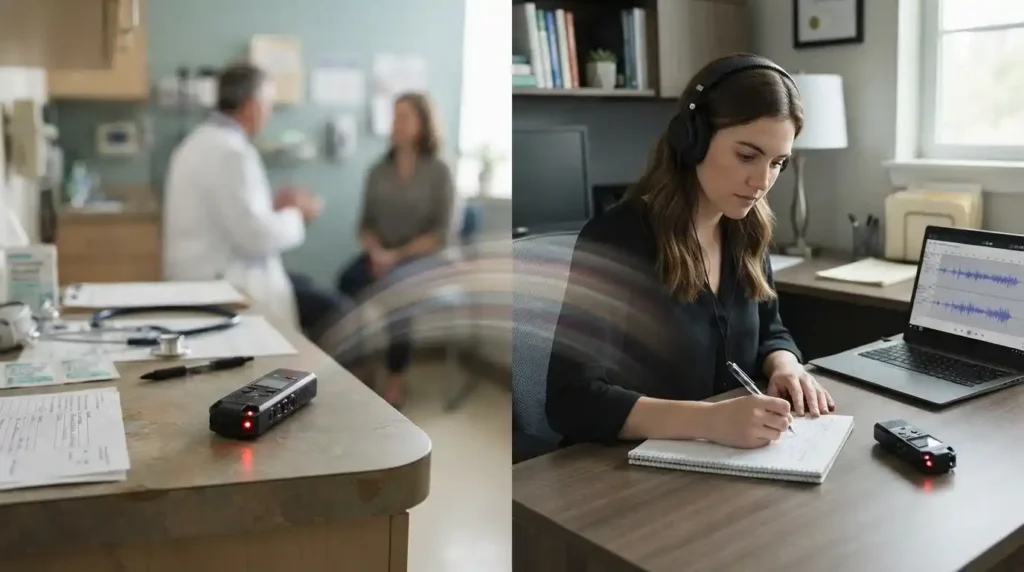
Asynchronous scribing flips the order. You record the visit - audio or video, with consent - and a scribe reviews and documents it later, on their own time, not yours.
You review the finished note once it's ready and approve it before it goes into the record. Same idea, just decoupled from your live schedule.
This model tends to suit practices where same-day chart closure isn't a hard requirement, or where coordinating a live scribe around your day just isn't worth the hassle. It's usually the cheaper of the two - you can see a fuller cost comparison between virtual and in-person scribing here.
The catch is the obvious one: there's a delay. Depending on the provider, that could mean a few hours or closer to a full day before documentation actually lands in the chart - which doesn't help much if you needed that note before your next patient walked in.
Where both models hit the same wall
Live and asynchronous scribing solve different problems - speed versus cost - but they share the same underlying limitation: they both depend entirely on one person's bandwidth. A live scribe can only keep up with one visit at a time, at human typing speed, and their accuracy can drift over a long shift. An asynchronous scribe is only as fast as their queue, and yours isn't the only chart in it.
That's the gap we built ScribeRunner to close.
The hybrid approach: AI drafts it, a licensed reviewer signs off on it

ScribeRunner runs on a model that isn't purely live and isn't purely asynchronous - it's AI-first, human-verified. If you want the full picture of why practices are making this switch, see why practices choose ScribeRunner. Here's what the hybrid model actually looks like:
- ScribeRunnerAI drafts the note : extracting and structuring the visit in minutes, not hours.
- A trained specialist reviews it : often a licensed physician, checking every line for accuracy and HIPAA compliance, same day.
- A supervisor signs off : final QA before it ever reaches your inbox.
The result is documentation that's ready to sign, not ready to edit, with charts typically closed within about 4 hours of the visit: faster than most asynchronous services, without needing a scribe live on every single call. We hold ourselves to a 99.8% accuracy rate and run 2-3x faster than the industry benchmark, all while staying HIPAA and SOC 2 compliant (ISO 27001 and ISO 9001 certified as well).
In practice, that means you get the turnaround speed people like about live scribing, the flexibility people like about asynchronous scribing, and accuracy that doesn't depend on one person's attention holding steady for an 8-hour shift. If you want to see what that's worth in real numbers, our virtual scribe ROI calculator and case studies break down actual practice savings.
So which one should you actually pick?
If you're comparing traditional live vs. asynchronous human scribing: go live if your setting needs same-day chart closure and you can absorb the cost and coordination it takes. Go asynchronous if you're more focused on trimming overhead and don't need documentation the second a visit ends.
But if you're weighing that decision at all, it's worth asking why you're choosing between two sets of tradeoffs instead of a model built to avoid both. That's the conversation most of our clients, physicians, specialists, hospitals, outpatient clinics - end up having with us. You can see how it plays out for practices like yours in our case studies, or check our full range of medical support services if documentation is just one piece of what's slowing your practice down.
FAQ
What's the real difference between live and asynchronous scribing?
Live scribing happens in real time, with someone on the call. Asynchronous scribing happens after the fact, from a recording.
Which one costs less?
Asynchronous, generally, you're not paying for a scribe to be available at your exact appointment times. See our full pricing breakdown for specifics.
Which is better for urgent care or the ER?
Traditionally, live scribing, since same-day chart closure matters more in fast-paced settings. ScribeRunner's hybrid model gets similar same-day turnaround without needing a live scribe on every call.
Is a hybrid AI-plus-human model actually accurate?
Ours runs at a 99.8% accuracy rate, since every AI-drafted note is reviewed and signed off by a trained specialist — often a licensed physician — before it reaches you.
Is it HIPAA-compliant?
Yes. ScribeRunner is HIPAA-compliant, SOC 2 Type II certified, and ISO 27001/9001 certified, and is currently pursuing HITRUST certification.
Bottom line
Live and asynchronous scribing were the two options for a long time, and each one still has its place. But you shouldn't have to trade speed for cost, or cost for accuracy. ScribeRunner was built so you don't have to — AI speed, human accuracy, charts closed in hours instead of days.
Ready to see it in action? Book a 30-minute demo and get your evenings back.