
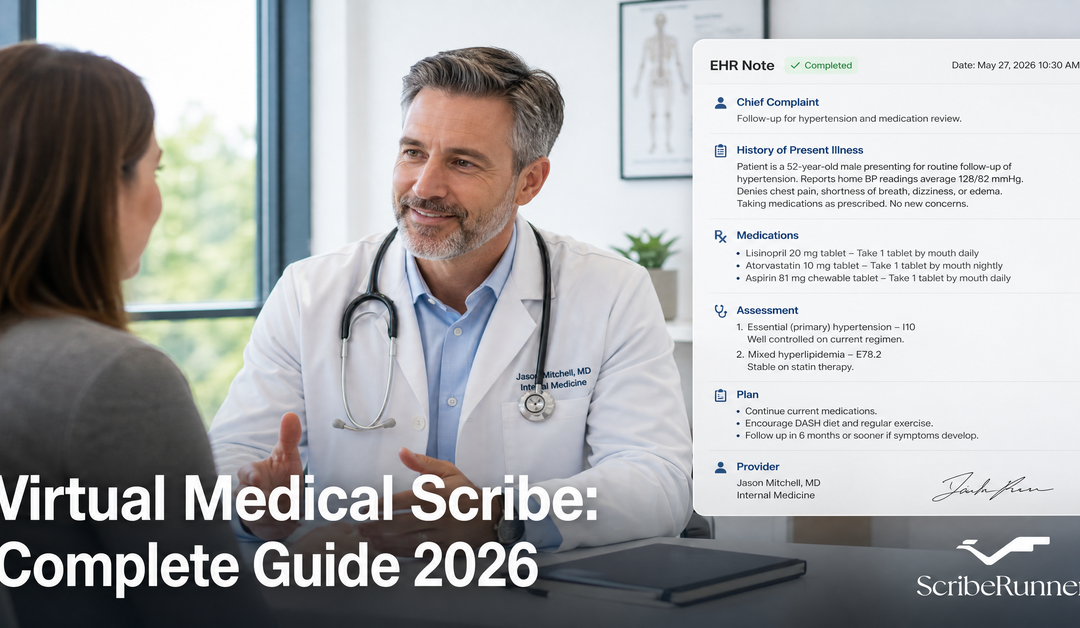
Physicians spend an average of 15.6 hours per week on documentation. Nearly two full clinical days buried in the EHR. For many, that number is higher.
A virtual medical scribe eliminates that burden entirely. Not by automating it. Not by outsourcing it to software. By putting a trained documentation specialist in every patient visit alongside you, in real time.
Here is exactly how it works.
What Is a Virtual Medical Scribe?
A virtual medical scribe is a trained documentation specialist who remotely joins your patient visits via a secure, HIPAA-compliant audio or video connection and documents everything directly into your EHR in real time, while you are in the room with the patient.
By the time the appointment ends, the note is done.
You review it, sign it, and move to the next patient. No after-hours charting. No staying late. No dictating into a recorder and waiting 24 hours for a transcription.
The scribe is remote. The documentation is real time. The note is in your EHR before you close the exam room door.
What Does a Virtual Medical Scribe Actually Do During a Visit?
Here is what happens from the moment a patient walks in to the moment you sign the note:
- Before the visit: The scribe pre-charts, pulling up the patient's prior notes, active problems, current medications, and pending orders so the chart is open and ready when you walk in.
- During the visit: The scribe listens via a secure connection and documents in real time:
- History of Present Illness (HPI), capturing the patient's story as you take it
- Review of Systems (ROS), documented as you conduct it
- Physical Exam findings, entered as you dictate or describe them
- Assessment and Plan (A&P), your diagnoses, treatment decisions, referrals, and follow-up
- Medication changes, lab orders, and patient instructions
- After the visit: The note is complete and ready for your signature. The scribe pre-charts for the next patient while you are still in the room.
That is the entire workflow. You talk to your patient. The scribe handles everything else.
What a Virtual Medical Scribe Is NOT
This is where physicians sometimes get confused, particularly around the difference between a virtual medical scribe and a virtual medical assistant. They are different roles. Understanding the distinction saves you from hiring the wrong one.
A virtual medical scribe does not:
- Speak to patients or answer patient questions
- Handle appointment scheduling or cancellations
- Process insurance verification or eligibility checks
- Manage prior authorizations
- Handle billing, coding, or revenue cycle tasks
- Make any clinical decisions whatsoever
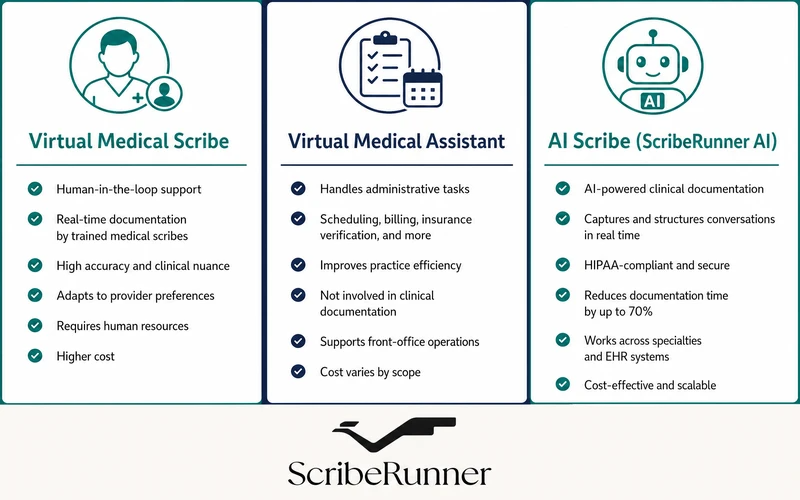
All of those tasks belong to a virtual medical assistant (VMA), a different role with a broader administrative scope.
The clearest way to think about it:
A virtual medical scribe is a documentation specialist. A virtual medical assistant is an administrative generalist who often handles documentation as part of a wider remit.
If your only pain point is charting, the hours you spend writing notes, your inbox piling up with unsigned charts, your evenings disappearing into the EHR, a virtual medical scribe is what you need.
If you also need help with phones, scheduling, prior auths, and insurance, you need a virtual medical assistant. ScribeRunner offers both. You can see the full comparison on our complete Virtual Medical Scribe guide.
How Is a Virtual Medical Scribe Different From From An AI Scribe?
This is the other question physicians are asking in 2026, and it is a fair one, because the market now has both human virtual scribes and AI-powered scribe tools, and they are meaningfully different.
Human virtual scribe: A real, trained person listens to your visit and documents it. They apply clinical judgment, catch ambiguous phrasing, understand specialty-specific terminology, and produce notes with contextual accuracy that comes from experience. For complex specialties like cardiology, psychiatry, and oncology, the human element still matters significantly.
AI scribe (like SAI): Ambient listening technology records the visit and a large language model generates the clinical note, which is then reviewed before delivery. AI scribes are faster, available on demand from a mobile app, and cost less per session. For standard primary care, family medicine, internal medicine, and urgent care visits, modern AI scribes now perform at a level very close to human scribes.
Which is right for your practice? If you run a high-volume, complex specialty practice and want consistent, supervised documentation, a human scribe is the better fit. If you are a solo physician, a telehealth provider, or someone who needs to chart from anywhere at any time without scheduling a scribe session, ScribeRunner AI is built for exactly that.
ScribeRunner is one of the few providers that offers both, so you are not locked into a single model as your practice evolves.
Is a Virtual Medical Scribe HIPAA Compliant?
Yes, when the service is implemented correctly. This is the question physicians should be asking more rigorously before they sign with any provider, because not all virtual scribe services meet the same compliance standard.
The three things to verify before onboarding any virtual scribe company:
- Do they sign a Business Associate Agreement (BAA)? This is non-negotiable under HIPAA. Any service that accesses Protected Health Information (PHI), which a scribe does by definition, must sign a BAA with your practice before accessing a single patient record. If a provider is reluctant to sign a BAA, that is a red flag and a legal risk.
- What encryption do they use? Audio and video transmission between your exam room and the remote scribe must be end-to-end encrypted. Standard consumer video tools do not meet this bar.
- How do scribes access your EHR? Scribes should have role-based access, meaning they can enter documentation but cannot access parts of your EHR outside their scribing function. Ask for specifics.
ScribeRunner signs a BAA with every practice before day one, uses a HIPAA-compliant communication platform, and provides role-based EHR access with full audit trails.
What Does a Virtual Medical Scribe Cost?
Pricing varies by provider, model, and volume but here are realistic 2026 ranges:
Human virtual scribe: $1,200 to $2,500 per physician per month, depending on hours of coverage and specialty complexity. On an annual basis, that is $14,400 to $30,000, compared to $44,000 to $65,000 for an in-person scribe when you factor in salary, benefits, payroll taxes, and training.
AI scribe (ScribeRunner AI): Subscription-based pricing, significantly lower than human scribing. Designed for physicians who want on-demand access without a per-session commitment.
The more important number is the ROI. One of our family medicine physicians went from seeing 8 patients per day to 12, a 50% increase in patient capacity, after adding a ScribeRunner virtual scribe. At an average of $150 per visit, that generated $187,000 in additional annual revenue against a $28,000 scribe cost. The practice broke even in under four weeks.

You can read the full breakdown here: How One Practice Hit 6.5x ROI With a Virtual Scribe
Who Needs a Virtual Medical Scribe?
The honest answer: any physician who is spending more than 30 minutes per day on documentation after clinic hours.
In practice, the physicians who benefit most are:
Solo practitioners and small group practices where there is no dedicated documentation support and the physician is personally absorbing every administrative burden.
High-volume primary care and urgent care physicians who see 18 to 25 patients per day and cannot afford to slow down for charting.
Telehealth physicians where the virtual model means a remote scribe integrates seamlessly with no additional setup and no physical presence needed.
Specialty physicians in cardiology, orthopedics, mental health, and dermatology where documentation complexity is high and specialty-trained scribes add real accuracy value.
Physicians experiencing burnout. The American Medical Association has consistently identified documentation burden as one of the leading drivers of physician burnout. A scribe does not fix burnout, but removing 2 to 3 hours of daily charting removes a significant source of it.
The Bottom Line
A virtual medical scribe is not a transcriptionist. It is not a voice recorder. It is not a workaround.
It is a trained documentation professional, or a purpose-built AI tool, that sits in every patient visit alongside you, handles every word of the chart, and hands you a complete note before you reach the door.
For physicians who are doing this work themselves at 9 PM, the question is not really what is a virtual medical scribe. The question is: how much longer are you going to wait?
ScribeRunner offers human-assisted virtual scribing and the ScribeRunner AI app, built for medical practices that are done charting on their own time.
Book a free consultation to find out which option fits your practice, or visit our complete Virtual Medical Scribe guide to go deeper on costs, HIPAA, specialties, and how to choose a provider.
📞 (786) 866-7849 | Monday to Friday 8 AM to 6 PM Eastern
Frequently Asked Questions
What is a virtual medical scribe?
A virtual medical scribe is a remote documentation specialist who listens to your patient visits via a secure connection and enters clinical notes directly into your EHR in real time, so the chart is complete before the visit ends.
How is a virtual medical scribe different from a virtual medical assistant?
A virtual medical scribe focuses exclusively on real-time clinical documentation. A virtual medical assistant handles broader administrative work including scheduling, insurance verification, prior authorizations, and patient communications, and may also handle some documentation. If charting is your only problem, you need a scribe. If you need full administrative support, you need a VMA.
Are virtual medical scribes HIPAA compliant?
Yes, when properly implemented. The provider must sign a Business Associate Agreement (BAA), use end-to-end encrypted communication, and give scribes role-based EHR access only. Always verify all three before onboarding.
How much does a virtual medical scribe cost?
Human virtual scribes typically cost $1,200 to $2,500 per physician per month. AI-powered scribes like ScribeRunner AI are available at a lower subscription rate. Most practices achieve positive ROI within 4 to 8 weeks.
Can a virtual scribe work with telehealth visits?
Yes. Virtual scribes are ideally suited for telehealth. Both the physician and the scribe are remote, and the scribe integrates directly into the video visit workflow without any additional equipment or setup.
ScribeRunner provides HIPAA-compliant virtual medical scribe services and the ScribeRunner AI documentation app for medical practices nationwide. Based in Miami, Florida.