
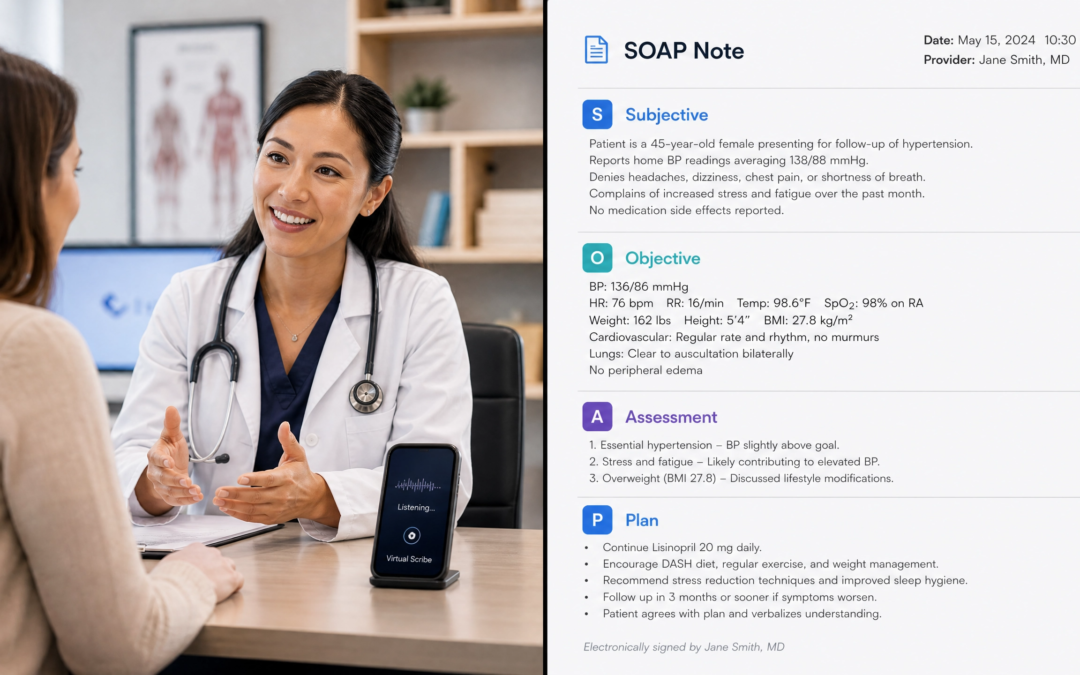
The average physician spends 15.6 hours a week on documentation. A growing number of them are turning to AI medical scribes to get that time back.
But AI medical scribing is one of the most misunderstood categories in healthcare technology right now. Some physicians expect it to be a voice recorder. Others expect it to replace human judgment entirely. Most are somewhere in between, trying to figure out whether it is accurate enough, whether it is HIPAA compliant, and whether it is actually better than what they are doing today.
This article explains exactly how AI medical scribes work, how they compare to human scribes, what they cost, and which type of practice they are actually built for.
What Is an AI Medical Scribe?
An AI medical scribe is a software system that listens to a physician-patient conversation, processes the clinical content using artificial intelligence, and generates a structured clinical note ready for physician review.
Unlike a traditional voice recorder or transcription service, an AI medical scribe does not produce a raw transcript. It produces a formatted clinical note, organized into the sections your EHR expects: HPI, ROS, Physical Exam, Assessment and Plan, and any other documentation your workflow requires.
The key word in that description is "generates." The AI drafts the note. A trained human reviews it before it reaches the physician. That review step is what separates a responsible AI scribing service from a raw AI output you cannot trust in a clinical setting.
ScribeRunner AI (SAI) is built on exactly this model: AI drafts, human reviews, physician signs. The result is documentation that is faster than a human scribe alone and more reliable than AI alone.
How Does an AI Medical Scribe Work?
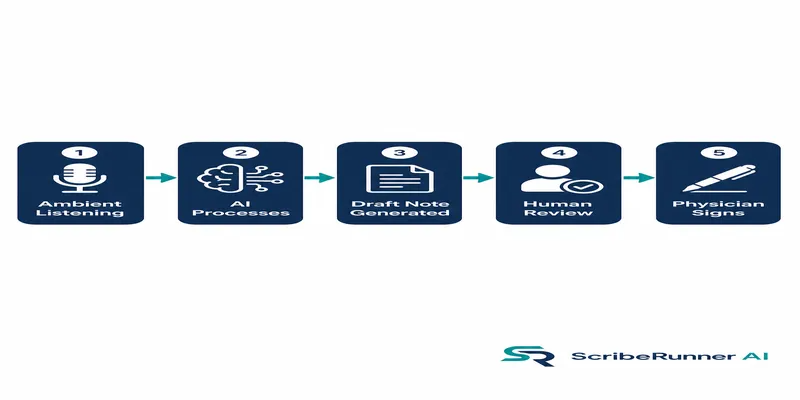
Here is the step-by-step process for a visit documented with an AI medical scribe:
Step 1: Ambient Listening
The physician opens the app or activates the scribe platform before the visit begins. The AI listens to the conversation through the device microphone or an integrated audio connection. No special equipment is needed. No dictation prompts. The physician talks to the patient normally.
Step 2: AI Processes the Conversation
As the visit unfolds, the AI identifies and organizes clinical content in real time. It distinguishes between the physician's questions, the patient's responses, and the clinical decisions being made. It maps this content to the correct documentation fields: symptoms become HPI, systems review becomes ROS, examination findings become PE, and treatment decisions become A&P.
Step 3: Draft Note Generated
Within seconds to minutes of the visit ending, the AI produces a structured clinical note draft. The note follows your EHR's format and reflects your documentation preferences over time as the system learns your style.
Step 4: Human Quality Review
This is the step that separates ScribeRunner AI from raw AI output. A trained clinical reviewer checks every note for accuracy, completeness, and compliance before it reaches you. Errors caught. Gaps flagged. Clinical language verified. You receive a note that is ready to sign, not a draft that requires your own editing.
Step 5: Physician Reviews and Signs
The completed note lands in your EHR or inbox for final review and sign-off. Most physicians report reviewing and signing in under two minutes per note. The chart is done before the next patient walks in.
AI Medical Scribe vs Human Medical Scribe: The Real Comparison
This is the question most physicians are actually trying to answer. Not "what is an AI scribe" but "is it as good as a human scribe and should I choose one over the other."
The honest answer is: it depends on your practice. Here is the comparison without the marketing spin:
Where AI Scribes Perform as Well as Human Scribes
- Standard primary care and family medicine visits
- Urgent care and walk-in clinic documentation
- Internal medicine follow-up appointments
- Telehealth visits across most specialties
- High-volume, predictable documentation workflows
For these visit types, modern AI scribing with human review produces notes that are clinically accurate, properly formatted, and ready to sign at a rate that matches or exceeds what most human scribes deliver.
Where Human Scribes Still Have an Edge
- Complex specialty visits: cardiology, psychiatry, oncology, neurology
- Procedures with highly specific documentation requirements
- Visits where clinical nuance, context, and judgment drive the note structure
- Practices with unusual or highly customized EHR templates
A human scribe who is trained in your specialty brings clinical intelligence to the documentation process that AI is still improving on. For psychiatry in particular, where the therapeutic conversation is the clinical encounter, AI processing has real limitations that experienced human scribes do not.
This is why ScribeRunner offers both. If you want the full comparison between human and AI scribing, the complete virtual medical scribe guide covers it in detail.
Is an AI Medical Scribe HIPAA Compliant?
Yes, when implemented correctly. But this is a question worth asking explicitly of any AI scribing provider because the technical requirements for HIPAA compliance in an AI system are more complex than most physicians realize.
An AI medical scribe that processes patient conversations is handling Protected Health Information (PHI). Under HIPAA, any system or vendor that handles PHI on your behalf must sign a Business Associate Agreement (BAA) and meet specific standards for data encryption, access controls, and retention policies.
For AI scribing specifically, the questions to ask are:
- Is the audio recording encrypted in transit and at rest?
- Where is the audio stored and for how long?
- Who has access to the audio and the generated note during the review process?
- What AI model is processing the conversation and where does that processing happen?
- Will you sign a BAA before any data is processed?
ScribeRunner AI signs a BAA with every practice before activation, processes audio through a HIPAA-compliant infrastructure, and operates under a documented data retention and deletion policy. The app is SOC 2 Type II certified and ISO 27001 certified.
What Does an AI Medical Scribe Cost?
AI medical scribing costs significantly less than full-service human scribing. The subscription model means you pay a flat monthly or per-note rate rather than a per-physician hourly or monthly coverage fee.
For context, full-service human virtual scribing runs $1,200 to $2,500 per physician per month. AI scribing with human review runs lower, making it particularly attractive for solo physicians, small practices, and telehealth providers who need documentation support without the full cost of a dedicated human scribe.
For ScribeRunner AI pricing, contact us directly or visit the pricing page. Proposals are ready within 24 hours.
For a full breakdown of what factors affect scribing costs across both models, see our virtual medical scribe pricing guide.
Who Is an AI Medical Scribe Built For?
AI medical scribing is the right choice for specific types of physicians and practices. It is not the right choice for everyone, and the best providers will tell you that honestly.
AI scribing is a strong fit if you are:
- A solo physician who cannot justify the cost of a dedicated human scribe
- A telehealth provider who needs seamless remote documentation
- A primary care or urgent care physician with high volume and predictable visit types
- A physician who needs on-demand access from a mobile device without scheduling a scribe session
- A practice evaluating scribing for the first time and wanting a lower-cost entry point
- A physician who travels between multiple locations or works irregular hours
Human scribing is likely the better fit if you are:
- A specialist in cardiology, psychiatry, oncology, or neurology where documentation complexity is high
- A multi-physician group that needs consistent, supervised documentation across the practice
- A physician whose EHR templates are highly customized and require judgment to populate accurately
- A practice that has tried AI scribing and found the accuracy insufficient for your documentation standards
If you are not sure which fits your practice, ScribeRunner's free consultation is built to help you figure that out before you commit to anything. We offer both models and have no reason to push you toward one over the other.
Common Concerns About AI Medical Scribes
Will the AI get clinical terminology wrong?
Modern AI medical scribes are trained on large volumes of clinical language and perform accurately on standard medical terminology across most specialties. The human review step in ScribeRunner AI's process catches errors before they reach you. That said, for highly specialized or procedural terminology, a specialty-trained human scribe remains the more reliable option.
What if the AI mishears something?
Ambient AI systems can misprocess audio in noisy environments, with accents, or when multiple people are speaking simultaneously. This is why human review before delivery is not optional at ScribeRunner. It is built into the process for exactly this reason.
Will patients know the AI is listening?
Best practice, and in many states legal practice, is to inform patients that an AI documentation system is in use during the visit. Most patients accept this without concern when it is explained as a tool that helps the physician focus on them rather than on a screen. ScribeRunner recommends a brief verbal disclosure at the start of each visit.
Does the AI learn my documentation style?
Over time, AI scribing systems adapt to individual physician preferences, common phrases, documentation patterns, and EHR formatting requirements. The longer you use it, the more the output reflects your style, which reduces review time and the number of edits needed before sign-off.
The Bottom Line
An AI medical scribe is not a voice recorder. It is not a transcription service. And it is not a replacement for clinical judgment.
It is a documentation system that listens to your visit, drafts a complete clinical note using artificial intelligence, puts a trained human reviewer between the AI output and your inbox, and delivers a note that is ready to sign before your next patient walks in.
For the right practice, it eliminates after-hours charting entirely at a price point well below traditional scribing. For complex specialties, the human scribing model remains the stronger choice.
ScribeRunner offers both. The complete guide to virtual medical scribes will help you understand the full landscape before you decide.
Book a free 30-minute consultation and we will tell you which model fits your practice, give you a custom proposal, and answer every question before you commit to anything.
Frequently Asked Questions
What is an AI medical scribe?
An AI medical scribe is a software system that uses ambient listening and artificial intelligence to generate structured clinical notes from physician-patient conversations. The AI draft is reviewed by a trained human before delivery to the physician for final sign-off.
Is an AI medical scribe HIPAA compliant?
Yes, when the provider signs a Business Associate Agreement (BAA) and processes audio through a HIPAA-compliant encrypted infrastructure. Always verify the BAA, data retention policy, and encryption standards before activating any AI scribing service. ScribeRunner AI is SOC 2 Type II and ISO 27001 certified.
How accurate is an AI medical scribe?
For standard primary care, urgent care, and internal medicine visits, modern AI scribes with human review perform at a high accuracy level. For complex specialties like cardiology, psychiatry, and oncology, human scribes currently offer stronger clinical accuracy. Accuracy improves over time as the system learns individual physician documentation preferences.
How is an AI scribe different from a human scribe?
A human scribe is a trained person who listens to your visit live and documents with clinical judgment. An AI scribe uses technology to generate the note automatically, with human review built in before delivery. AI scribes are faster, available on demand, and cost less. Human scribes offer stronger accuracy in complex specialty and procedural documentation.
How quickly can I start using an AI medical scribe?
ScribeRunner AI can be activated the same day. There is no multi-week onboarding process. Book a consultation, complete the HIPAA setup and BAA, and you can be live with your first AI-scribed visit within 24 to 48 hours.
ScribeRunner provides HIPAA-compliant virtual medical scribe services and the ScribeRunner AI documentation app for medical practices nationwide. Based in Miami, Florida.